
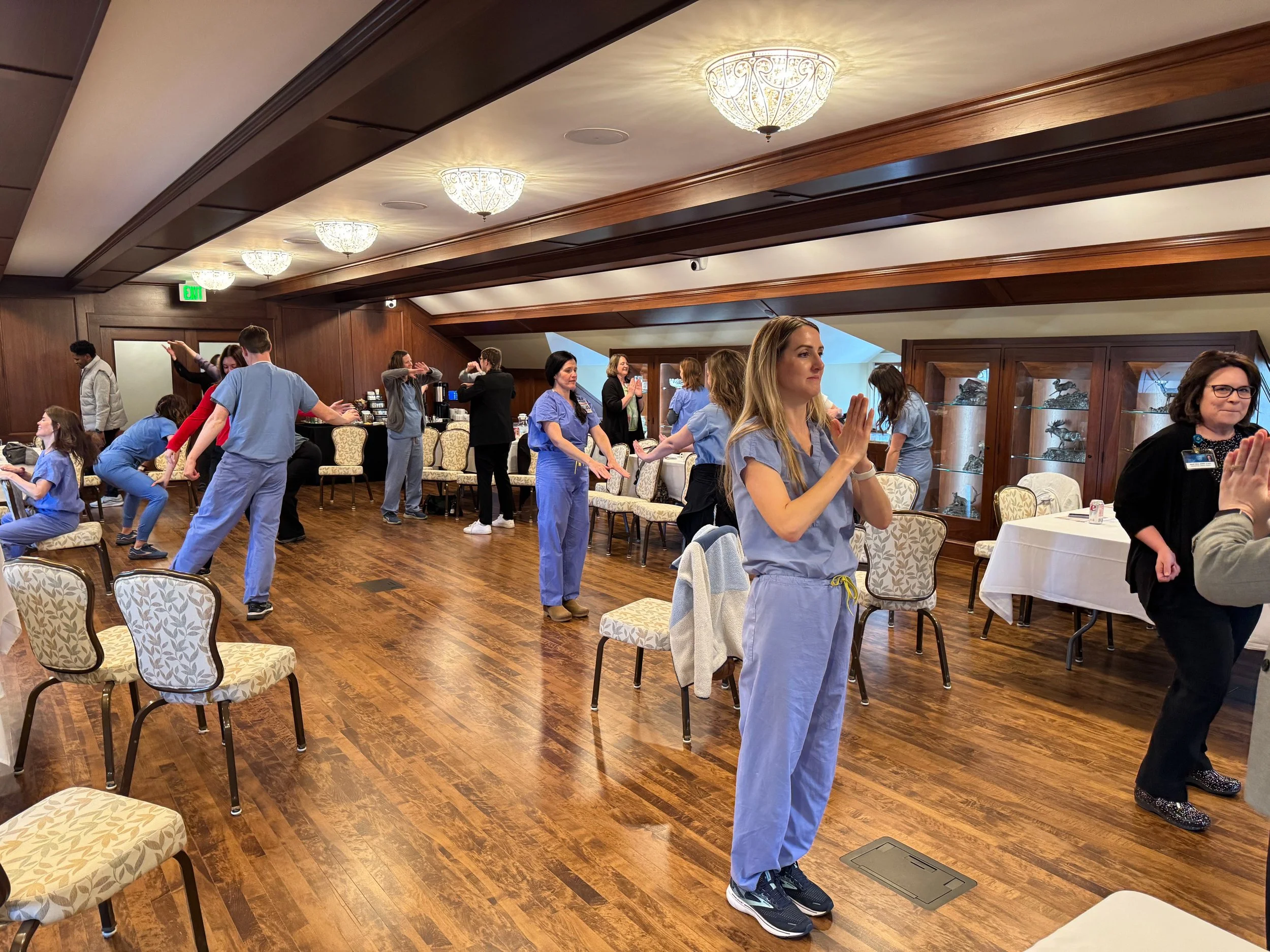
Photo: An improv workshop for medical professionals at Mayo Clinic led by Danger Boat co-founder Tane Danger.
Why Your Healthcare Organization Needs an Improv Workshop
At Danger Boat Productions, we’ve always believed that improv is more than entertainment.
That idea is at the heart of a new research article in Mayo Clinic Proceedings, co-authored by Danger Boat co-founder Tane Danger, who also teaches improv to medical professionals as Artist in Residence at Mayo Clinic’s Dolores Jean Lavins Center for Humanities in Medicine.
The article, “Exploring the Promise of Improvisational Theatre Applications in Health Care,” reviews decades of research starting in 1973 on how improv is being used in healthcare settings. The authors screened 694 sources, reviewed 135 full-text articles, and selected 81 for analysis. They saved you thousands of pages of reading — and we’re saving you even more by summarizing the key takeaways here!
Across 50 years of studies at healthcare orgs around the country, most programs had common goals like improving communication, teamwork, self-confidence, and public speaking. They achieved those goals by building up skills that are integral to improv: listening, empathy, observation, cue recognition, and collaboration.
In short, improv isn’t just what actors on The Pitt do to warm up before takes, it’s a valid learning tool in Healthcare that is only becoming more popular.
Why this matters
Healthcare depends on the human connection, not just knowledge from a textbook.
A doctor needs to notice what a patient is saying or not saying. A team needs to adjust when plans change. A caregiver needs to stay present in the moment of uncertainty. These are not “soft skills". They’re essential, and can literally be the difference between life and death.
Improv helps people practice them. The review notes that applied improv programs often use a consistent structure: an activity, coaching from a facilitator, and debriefing afterward. That makes the learning active, memorable, and immediately applicable.
So would improv skills help a radiologist when they do their Friday night set at the comedy club? Yes. Would it also help them with their bedside manner? Also yes.
The Big Takeaway
The research reinforces something we see in our work every day: improv gives people a practical way to rehearse being more present, responsive, and collaborative. That matters in healthcare. It also matters in every organization where people need to communicate clearly, navigate uncertainty, and work better together.
Imagine how many "this should have been an email" meetings you could cut down on if the people you worked with were trained to be really good at listening.

Work with Danger Boat
Danger Boat Productions helps healthcare systems, universities, nonprofits, companies, and public agencies use improv to make communication, collaboration, and complex ideas more engaging.
If your team is looking for a workshop, keynote, or custom event that builds real skills while keeping people awake and laughing, let’s talk.
