
The Art of the “No”: Why Partnerships Fall Through
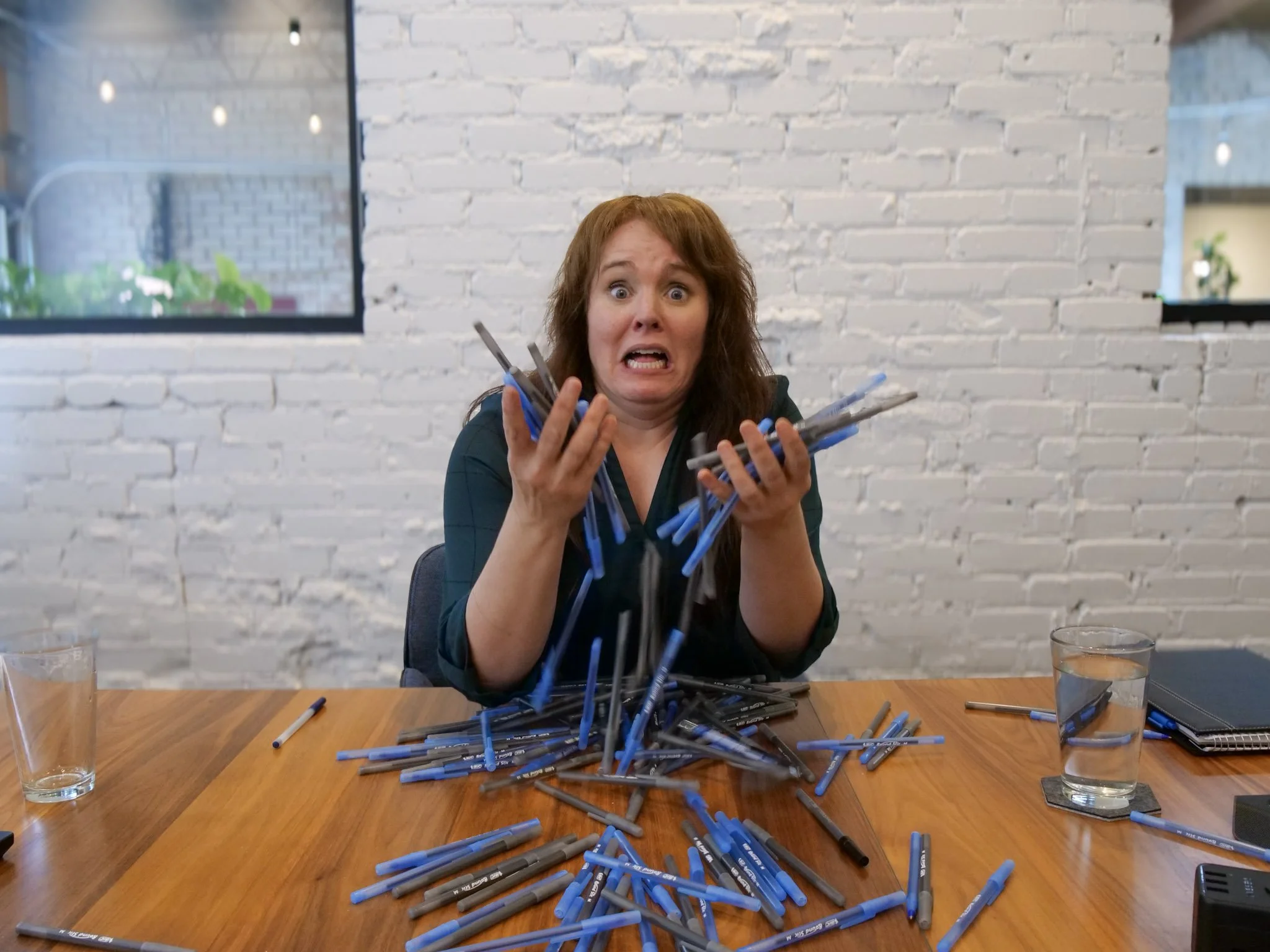
Danger Boat cast member Heather Meyer analyzing why their pens have fallen through.
The Art of the “No”: Why Partnerships Fall Through
by Brandon Boat | 15 min read
This is part of a series of blogs on how we at Danger Boat Productions think about and understand our business. It’s a peek behind the curtain about our process, but the act of writing also helps us better analyze and articulate how we work.
Our hope is that the series helps potential clients make more informed decisions about working with us. It also may be useful for other folks that have similar service-based businesses.
Today, we’re looking at a simple but important question:
Why do organizations reach out to us, but not end up hiring us?
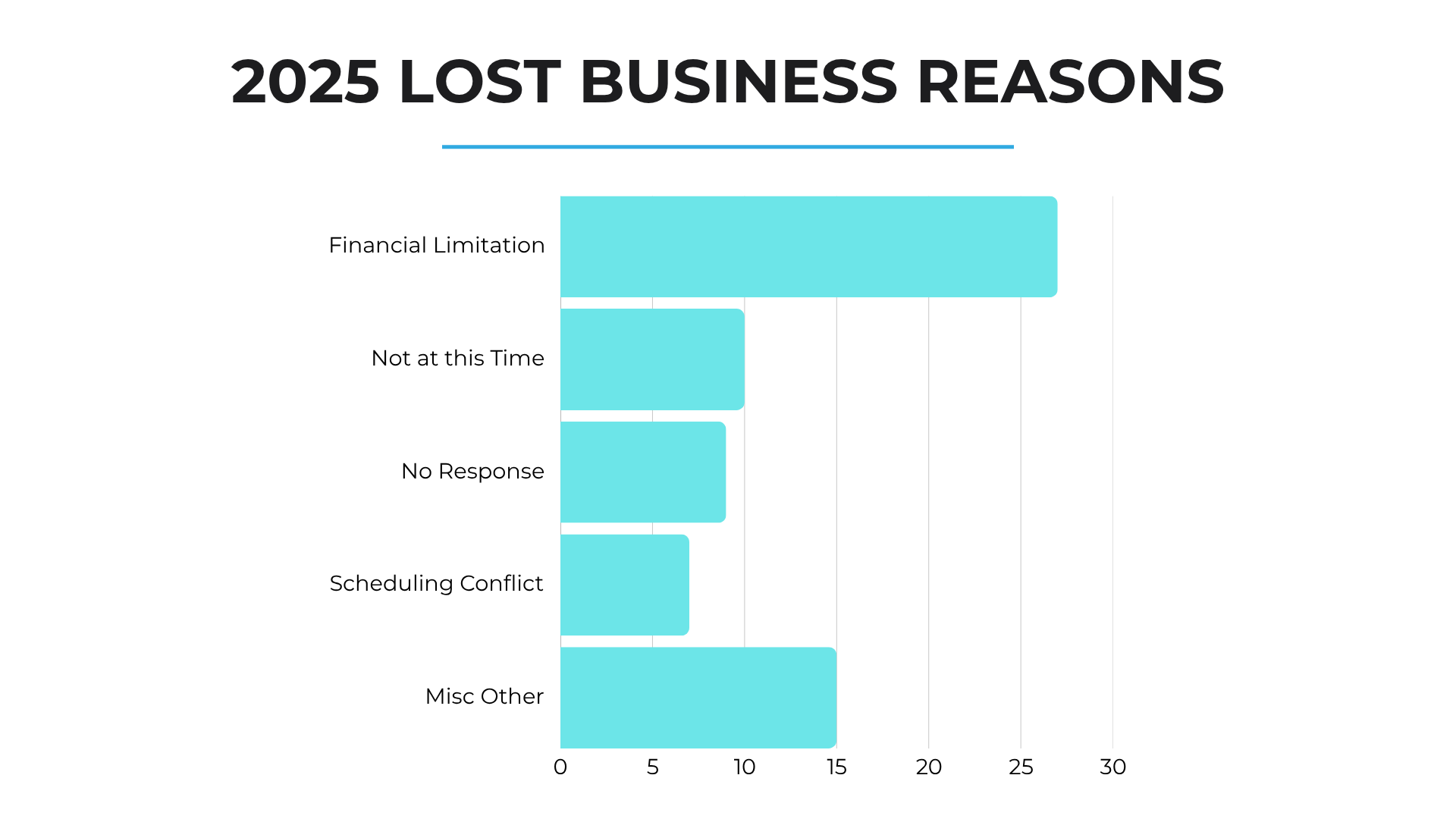
2025 Lost Business Reasons, Danger Boat Productions.
Where the Data Comes From
The data we’re looking at comes from sales inquiries we received in 2025.
Our Production Manager, Brian Gioielli, handles many of these incoming requests. He logs the information in our CRM system, introduces ourselves, evaluates the needs of the potential client and explains our services.
In 2025, I asked Brian to start tracking and coding why partnerships fall through and don’t lead to a signed contract. We started with five categories:
Financial Limitation
Not at this Time
No Response
Scheduling Conflict
Misc/Other
This data represents 68 organizations that declined to hire us last year.
Our goal was to better understand where we were losing potential work, whether any patterns were emerging, and what we might do to reduce the number of “no thank yous” we receive.
Financial Limitation
This is the category where we’ve traded emails, shared a laugh in meetings, sent our proposal, but found out that what we're offering is outside of the organization's price range.
This can happen for any number of reasons.
The event or training may have a fixed budget and what we offer is beyond what they’ve allocated. A state agency may have procurement rules and anything above $5,000 is required to go through an open-bid process. Or the client may be unfamiliar with the market and not realize there is a significant price difference between a generic keynote and a highly interactive experience.
We’ve put a lot of thought into how we’ve priced our services.
When we relaunched Danger Boat Productions in earnest in 2024, we made the decision to raise our prices across the board. We had a lot of conversations with other business owners on how to arrive at the right number. One piece of advice we received was that if no one is saying no because of price, you are probably not charging enough.
That can be hard to accept. It’s painful to turn down opportunities because of price. But we don’t want to go back to our early days of doing shows for $200 and a slice of pizza. Unless the pizza has golden toppings, of course.
I’m currently a member of the Entrepreneur’s Organization Accelerator program and my business coach has a slightly different take. His view is that when someone says they cannot afford us, we may not have done enough to communicate the value of what we offer.
His argument is that budgets are often more flexible than they appear. If an organization is convinced that the expense is justified, they may find additional money. We have seen this happen. Nonprofits have applied for grants, tapped donors, found sponsors, or aligned our work with funding that had a specific purpose.
In other words, price may be the reason someone says no. But it may also be a sign that we haven’t yet made the value of our work clear enough.

Not at this Time
These are the partners that want to hire us, but are not able to move forward right now.
The reasons vary. They may be in the early stages of planning a conference, only to have the dates or funding fall through. Their organization may experience an unexpected challenge that forces them to cut costs. Leadership may change. Priorities may shift. The project may simply lose momentum.
In these cases, something external prevents them from saying yes.
For us, this is an important group to remember. These organizations are often sold on the idea of working with us, but the timing is wrong. That means our job is not to treat them as lost forever. It is to follow up later, stay connected, and see whether circumstances have changed.
A “not right now” may become a “yes” next year.

No Response
Ghosting. The coward's way of breaking up.
This is when an established conversation suddenly goes dark. At this point, we have usually exchanged emails, had a meeting, and sent a formal proposal. Then, for whatever reason, we never hear back.
Maybe they no longer want to hire us. Maybe they got busy. Maybe they dislike delivering disappointing news. Maybe they changed jobs. Maybe our proposal is sitting in an inbox next to 400 unread newsletters and one very aggressive reminder from a dentist.
We may never know the real reason. But “No Response” is still an important metric to track.
One solution we have discovered is the power of picking up the phone. Brian is not afraid of the phone, and he will call people who have stopped responding to follow-up emails.
With surprising speed, people who have ignored several emails will often reply shortly after he leaves a voicemail. It does not work every time, but it has worked often enough that we now consider it an essential part of our follow-up process.
Scheduling Conflict
In this category, we are usually the ones saying no.
Sometimes we are already booked on the requested date. Sometimes we are double or even triple booked. We have a deep bench of performers, facilitators, and creative professionals, and we can often handle multiple shows or workshops in a single day. But even we have limits.
Other times, the client is looking for a specific person. Often, people want to book Tane Danger or no one else. If Tane is already committed elsewhere, we may have to decline.
There are a few possible ways to address this.
One option is to let the market decide and raise prices during our busiest seasons. We know when demand is highest, and we could allow our calendar to go to the clients who are willing to pay the most.
Another option is to increase our capacity. But that is easier said than done.
Are we trying to increase our ability to deliver great shows? Great workshops? Great hosting and emcee services? Each of those offerings requires a different set of skills, training systems, materials, and quality controls.
With our current administrative capacity, we cannot scale all three at the same time while maintaining consistent excellence. We would need to choose one or two areas to prioritize first.
Even then, developing talent takes time. It can take months or years to turn a good performer, facilitator, or host into a great one. That is a long timeline when the market need is immediate.
Miscellaneous / Other
This is the catchall category.
It includes everything too specific, unusual, or unclear to fit neatly into another bucket. I do not have a grand theory for this section other than this: if you can imagine a reason someone might not hire us, it probably lives here.
This category is also the hardest to solve for. The reasons may be too individualized to address with a broad strategy. Maybe the event changed direction. Maybe a selection committee preferred a different style. Maybe someone involved simply does not like improv.
That last one is a tough obstacle. But we’re happy to recommend good magicians or ventriloquists.
What We Learned
The goal of tracking this data was to better understand why potential partnerships fall through and whether there is anything we can do about it.
A few next steps stand out.
First, we can expand the data set. More information will help us see what is consistent year to year and what may be an anomaly.
Second, we can track where inquiries are coming from. A person who learns about us through a news article may need a different sales approach than someone who sees us perform live or clicks an ad. Understanding the marketing channel could help us tailor our follow-up.
Third, we can track our interventions more intentionally. If we change our proposal materials, adjust pricing, improve our follow-up process, or alter how we explain our value, we should measure whether those changes affect close rates.
Fourth, we can compare our data to similar organizations, if that information is available. It would be helpful to know whether our numbers are strong, average, or concerning. The challenge is that most organizations do not freely share this kind of information, so the comparison may be difficult or impossible to find.
Conclusion
Tracking lost inquiries does not make every “no” easier to hear, but it does make those answers more useful. Instead of treating each missed opportunity as a mystery, we can start to see patterns around price, timing, communication, capacity, and fit.
That helps us make better decisions and improve our sales process for us and for our clients. It helps us understand where we need clearer messaging, stronger follow-up, or better systems. And, perhaps most importantly, it reminds us that not every “no” means the same thing.
Some people are not the right fit. Some need a different timeline. Some need a clearer understanding of the value. Some may come back next year.
For Danger Boat, the point is not to chase every possible client. The point is to better understand which opportunities are worth pursuing, which ones need more nurturing, and which ones we should let sail away with grace, dignity, and maybe one final follow-up voicemail.

Author: Brandon Boat (he/him)
As co-founder of Danger Boat Productions, Brandon has produced and/or performed in more than 1000 shows that have delighted and surprised audiences throughout the US. In addition to performing, Brandon oversees the logistics of all Danger Boat’s productions and the company’s daily operations and finances as well as cast coordination, client collaboration and so much more.
