




Public forums meet improv comedy on The Theater of Public Policy
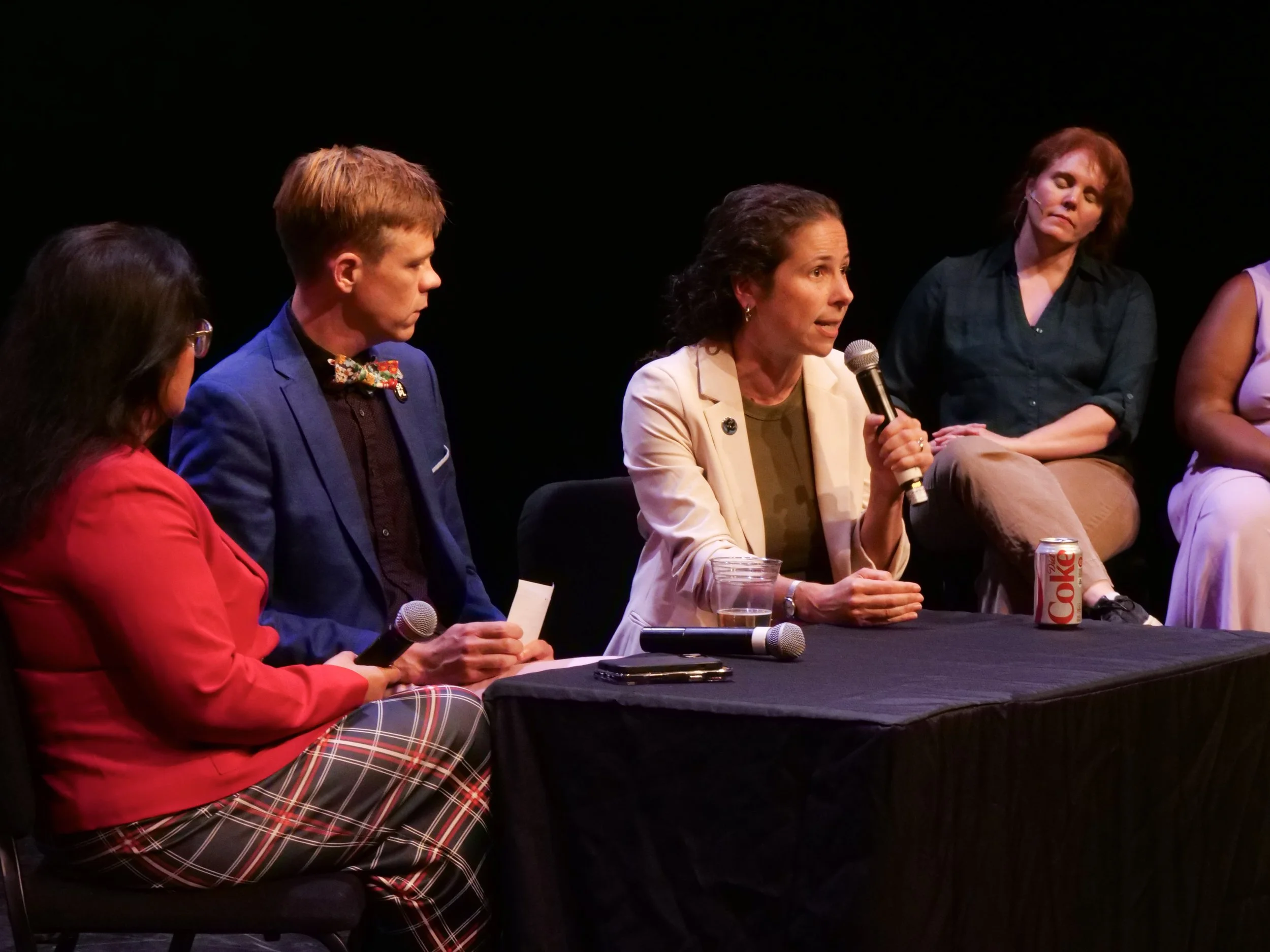
On Tuesday, September 8th, 2026, we invited St. Paul’s mayor, Kaohly Her, and their council president, Rebecca Noecker, to join us for a public onstage conversation about the city’s issues. Host Tane Danger asked them about a WIDE range of topics, including:
How the ongoing investigation into Mayor Her’s conduct is affecting city hall
The city’s response to the housing crisis and encampments
The recent ordinance to ban Flock cameras in St. Paul
Budget cuts and tax levies
and much, much more.
Listen to the full interview, including both city leaders giving answers to some audience-submitted questions, below.
Next time, see it live!
This audio recording was taken at a live show that you can actually go see! We have a full season of exciting and important public conversations to finish out 2026. Witness the magic of public dialogue and civics-inspired improv comedy, only at T2P2.
Transcript
Tane Danger:
Hi, I'm Tane Danger, the co-founder of Danger Boat Productions and the host of the Theater of Public Policy. If you've never seen the Theater of Public Policy before, it's a show where I typically interview one or more very smart people up on stage about a big issue or set of topics. And then we have this team of very talented improvisers who bring everything that they have talked about to life through entirely unscripted improv comedy theater. We've been doing this show for about 15 years and we were on a bit of a hiatus, but we are back. And we just had a very interesting, important, compelling conversation at the Theater of Public Policy with two guests, St. Paul Mayor, Kaohly Her, and St. Paul City Council President Rebecca Noecker. This was a show we did September 8th on the campus of St. Catherine University, the year of 2026 for however long into the future, somebody goes back and checks this.
And it was a great conversation. I will be honest, I was a little nervous going into this because when I did my research and wrote my questions ahead of time, there were a lot of very big, frankly, heavy topics to put to both of these leaders. There's currently an open investigation into Mayor Her's communications and conduct with the St. Paul Police Chief. There are currently a big debate going on what to do with the encampments of homeless individuals living in St. Paul. And the mayor has moved forward with clearing some of those camps and that has caused a lot of consternation. There are budget battles going on right now. The mayor has proposed budget cuts in order to try and keep down property taxes, which have been going up pretty dramatically in St. Paul for a number of years. You have all of that, and then you got flock license plates, solid waste contracts, and the future of downtown.
So we had a lot to cover, but as I said, I think it turned out to be a good conversation. I think that these two leaders, while you may or may not agree with their specific policy positions or proposals, actually engaged with every topic that I put to them. They had things to say from both a policy perspective as well as what are the levers of government that can or cannot address some of these issues. So we decided to put this up online for people to be able to listen to this entire conversation. Fortunately, you don't get the improv part. You have to actually come to our shows for that part. But this is the audio recording of our conversation with St. Paul's mayor and city council president from just earlier this week. Quickly, I want to say thank you to the Minneapolis Foundation for being a sponsor of the Theater of Public Policy, as well as City Cast Twin Cities, who is our media partner on this show in particular.
So please, a big thank you to Minneapolis Foundation. And if you haven't before, check out City Cast Twin Cities, a great daily news podcast and newsletter that keeps you up to date on all things Twin Cities. So with that, let's go to my conversation with Mayor Kaohly Her and Council President Rebecca Noecker.
And now I am very excited to have these two guests joining us for a big conversation tonight. As I said, I am going to be asking them questions at the beginning of this show. Second half, we're going to open it up for you all. But please, full extensive bios of both of them are in your programs. They both have accomplished many things more than I will get to here. So I'm just going to say, please make a big round of applause as we welcome to the stage St. Paul's mayor, Kaohly Her and City Council President Rebecca Noecker. Give them a round of applause as they come on down. I'm going to sit in the middle. I'm going to sit in the middle. I'm going to sit in the middle here. You sit over there. There you go. Hi. Hi. Hi. Hi. Yeah, thank you. I thought that
Rebecca Noecker:
Was our beer, but that's your
Tane Danger:
Beer. How many beers can we have? We should just
Rebecca Noecker:
Have one.
Tane Danger:
Yeah, just have one. It's a good Catholic school. There has to be at least one beer on stage. Okay. Thank you all so much for being here. I'm very grateful. This is a true story. I reached out to you all about being on the show months ago and you all said yes almost immediately. Then we set up a show with Mayor Jacob Frey and Council President Elliott Payne. That was actually, they were very, very reticent and I kept being like, yeah, well, the St. Paul mayor and the St. Paul City Council president said yes. And so thank you for being a good example and getting up on stage.
Kaohly Her:
That's because we like each other.
Tane Danger:
Oh, you're good? Yeah. Can you hear me? Yeah, there you go. Yeah. That's good.
Rebecca Noecker:
That's because we like each other. Well, and we like to show up Minneapolis.
Tane Danger:
Yeah. That's great. But then there's been all kinds of news and stuff since then. Yeah. But I appreciate that you all are still here. I hope that everybody's still happy by the end of the show. So I'm going to do sort of the big elephant in the room one first. There is an ongoing investigation going on in the city of St. Paul. So there are accusations by Police Chief Axel Henry filed a complaint alleging a variety of misconduct and sexual communication and a variety of different things that are going on. There's been a wide variety of things that have been written about this, and the investigation has been going for a while and is still ongoing. And what I've heard you say on multiple occasions about this is that you are not going to comment on an ongoing investigation. Is there a way I can ask this where you will comment on it?
Kaohly Her:
The answer is no, and then the answer is yes. So it is an ongoing investigation and I think it is really important to maintain the integrity of that investigation. And so I look forward to it wrapping up so that I can talk openly about it because there is a lot that people should know and I would love to share that one in the time spread.
Tane Danger:
Do you have faith in the way that the investigation is going right now?
Kaohly Her:
Well, I mean, I was told that these investigations. I've never had an HR complaint against me. I'm 53 years old. I've been working a long time. This is the first time ever. And I was told that these usually go a week to four weeks. It has been months. So I don't know if that's a good thing or a bad
Tane Danger:
Thing. Why is it taking so long? That's been a question I've heard from multiple sides. As the public, don't we just want this to be out there?
Rebecca Noecker:
Yeah, I wish I knew. I mean, to the mayor's point, I hope it's because they're doing a thorough job. The city council is certainly eager for it to wrap up as well. Personally, I think it's a major distraction from the really good work that we're trying to do in the city.
Tane Danger:
Okay. Major distraction. This is one of the pieces that I do feel like I understand not commenting on the actual things within the investigation. However, I do think it's fair to ask, is this affecting city business? Is the tension or the accusations, the fact that the police chief and the mayor have an open investigation between them making it harder for you and for the police department to do work together?
Kaohly Her:
So it has not impacted my ability to do my job. Yeah, this one isn't really working. Can you hear me now? Yeah, there you go. Okay. So the business moves forward. I mean, if you look at everything that we've accomplished in the first nine months of eight months of being here, we have done a lot in the city of St. Paul. And so this investigation started back in April. So if there was an indication of that we are moving forward with business, we are moving forward with business.
Tane Danger:
Do you and the police chief talk to each other?
Kaohly Her:
There's tension, but I'm also somebody who believes, I think anywhere any of us have ever worked, we've not gotten along with everybody that we've ever worked with and the work continues. And so I'm a person who believes that personality should not get in the way of work getting done and that if somebody is willing to work with me, I'll always work with them even if we don't like each other.
Tane Danger:
And you said it's a huge distraction. How is this playing out from the council's point of view?
Rebecca Noecker:
I think it's a huge distraction in the public eye because this is what we're talking about right now. And so other things, for example, you're leading with this. Oh, I can't wait. But it's the elephant in the room, as you said, right? But actually it's not affecting the work we're doing as a council. We're deep in budget season. We're deep in dealing with all kinds of issues, which I'm sure you'll ask about. I think it's just one of those things that then people think about and it's hard enough to get people's attention on local government and on local issues. And when that's what the conversation goes to, then we can't talk about all those other things that are important.
Kaohly Her:
Tane, can I just add though, council president and I meet weekly. We call all the council members when we have an issue that's coming up or we want them to be aware. We are much more communicative than any other mayor before us because that is important to us. So regardless of what other relationship is with the chief is that we have relationships with our city council members, we have relationships with our county commissioners, with our state legislators, because the work really does continue and it takes all of us. City government doesn't run by itself. So I just want to just shout out to council president who has been a really great partner of mine. And even in initiatives that I'm working on, I ask every council member, if you're interested, work with us. We're not going to be an administration that works on something and then just springs it on people and say, now what do you think of this?
We've brought them in on every topic that they may care about to work with us so that we can do this hand in hand. So the work continues.
Tane Danger:
And one last push on this and then I will go to some of the other issues. I mean, you say there's tension with you and the police chief and yet you're still able to get work done. Are you able to work directly with the police chief right now?
Kaohly Her:
So we created a structure in which I'm being very honest with all of you and I probably should have more of a filter and I shouldn't be so honest, but -
Tane Danger:
I'm the one drinking a beer.
Kaohly Her:
We have a structure, a command structure now because I used to work directly with him and I'm somebody who's a very accessible person. So whether you're a director or you're a line employee, you can come directly to me. That is not how city hall has ever worked before. You only talk to the mayor if you are like the deputy mayor or an elected. That's not the way I work. So I work with every person regardless of what level of position that you hold. And so we have set it up now where it's not because of my discomfort, it's that I want to make sure that if somebody says they felt uncomfortable with me, I don't want to force them to have conversations with me. So I work with the deputy chiefs, I work through my assistant mayor to make sure that everything that we need to get done still gets done.
This is really for me just wanting to protect somebody who is making an accusation about me. I want to make sure that they feel comfortable and they're not forced to engage with me if they do not want to. Okay.
Tane Danger:
That's good. Okay. All right. And again, people are writing down their questions. They might have more questions, but let's go to other fun stuff. A budget. Yeah, I know. So you have proposed $887.8 million budget for the city next year, that would include a 6.8% levy increase. And there's specific parts of this that there are cuts in this because originally, if I have this right, it was going to be something like an 11%, 12% levy increase. And so by finding cuts and savings in a variety of places, the levy was able to be lowered to 6.8. And I realize you all are the council and the mayor's office are working through this right now, but some of the hot button ones are the St. Paul police officer's counts dropping from 615 to 608. So there's a handful. 605, sorry, thank you very much. 605. You can read my handwriting better than I can.
605, they've also been asked to find some savings. One of the ones that's gotten a lot of attention is closing the Dayton's Bluff Library. So again, I'm imagining both of you are going out and talking to constituents a lot about this right now. How do you frame to people that you believe that making those cuts is worth having a lower property tax levy increase?
Rebecca Noecker:
Well, I think it's first of all important to point out that this is the part where the mayor and I are supposed to disagree because we are two different branches of government and it's the role of the council to look at the mayor's budget, try to find ways that we can make changes, try to make amendments. So the mayor's proposed a budget, some of which I like, some of which I don't like. And I think one of the most difficult parts of the budget for me are those cuts. One of the things the council has always really tried to do whenever we've had to make difficult decisions, which is by the way, every single year, and that's a systemic issue that we need to talk about and I hope we talk about here, is to try to save those services that people most depend on, those what we call frontline services.
So when you think about the city, the libraries, the rec centers, the police and fire, the things that the potholes, we don't need to keep those, we need to fix those. Those are the things that I think people think about when they think about city services. And so trying to hold those harmless has been a priority of the council over time. So those are the things that I struggle most with in the proposed budget.
Tane Danger:
So which ones are the ones where you're like, just right now I can't.
Rebecca Noecker:
So the Dayton's Bluff Library closure, closing rec centers earlier or cutting back on hours there. I mean, I think those are some of the things that people are going to most feel in their daily lives. And those are the things that we're going to be trying to find ways to preserve if we can.
Tane Danger:
And would potentially doing a larger property tax levy be worth it to you to save those things?
Rebecca Noecker:
That's the conversation that we have to have because I think on the other hand, I don't think a lot of people. Right. So I think the other thing to hear from people is we really don't want taxes to go up. So one of the things we've done in the past is we found ways to bring the levy lower than the mayor's proposed, and we found other ways to bring in revenue or other ways to find savings to allow us to not make cuts. Now, I will say the mayor has an immense financial acumen, a business background, and she has taken a very close look at this budget. So this is a challenge for us. I'm going to be the first to say, I don't know if we're going to be able to do it. I think she has probably looked at this budget line by line and has not been able to find anything.
But in the past, there were creative ways. One example I'll give you a couple years ago, we talked to our fire department and we found out that we were charging some of the lowest rates for transport when people go to the hospital in an ambulance of any place in the metro area. And those are charges that are normally passed on to insurance companies. So it's not something that the city taxpayers are paying. It's not something the individual's paying. And so we raised those rates. And this year we though we'd bring in about $2 million more. We brought in $5 million more a year in those transport fees, just bringing us up to average with the rest of the Metro. So there are examples like that where, again, I am sure the mayor has gone through this budget with a fine tooth comb, but those are things that the council has identified in the past that we've been able to avoid really painful cuts or raising taxes too much.
Tane Danger:
So this is why St. Paul used to be the best place to slip and fall. I know. Not anymore.
Kaohly Her:
But can I just say though that that particular example, I was at the state legislature and I worked with firefighters really closely and I used to meet with the fire and I was the one that said to them, look at your reimbursements because we are the only city that delivers emergency services from our fire department. And I was on the health committee at the time and I knew what hospitals were struggling with and the reimbursement rates. So even before I was the mayor, I was working with fire to say, what is it that you are not looking at to generate more revenues? And that's why they went back and looked at that and did that. And so I will say that in every department, when I got into city hall, I said, how are we going to raise revenues not on the backs of our lowest income residents, but places in which we actually haven't renegotiated contracts since 1991 and we're having people pay us 1991 rates when we're saying reimbursement rates, what is it that we are doing and what are the other things that we're doing?
We do inter-facility transports. We don't get paid for those when fire does that. When they take you from one hospital to another hospital, we do not get paid for that. If an emergency vehicle comes to the scene and they do not transport you, we do not get paid for that. And so I started saying line by line, what do we need to look at? When I look at even police, what is our impound lot? What is the cost of that? What is the cost of us to run that? We looked at even like Como Zoo and say, that is a regional park. The state is supposed to pay 40% of the cost of the regional park. They pay us 7% of that. That means we get $1.6 million to run a park. Who pays for the rest of that? All of you do. And so I looked at every single line item, every single negative fund.
I looked at every single. I even looked at what has been our return on investment on the cash that we have on hand. And we weren't meeting benchmark on one of them. And I though, why are we paying a money manager to manage our money when they're not even meeting benchmark? I can meet benchmark and I don't do this for a living. And so I said, we need to reevaluate every single thing because if I brought in just 1% more on our investments, that's millions of dollars more that our taxpayers do not have to pay for. So I have looked at every single thing I possibly can to have put together a balanced budget and to say that how can I not have this on the backs of our residents here? And so I am more than willing to dive deeper into this for all of you to know what we went through to get to the budget that we sent forward to the council.
Tane Danger:
That is the most impassioned address about a budget I've ever had, which I appreciate. So when you officially delivered your budget in the address, you had a line where you said, "We cannot defer our way to sustainability." So can you say a little bit more about that and maybe talk about what are some of the ways that we had been or St. Paul had been deferring things and you're like, "We can't keep doing this."
Kaohly Her:
So I'm going to be a little bit nerdy here for just a second.
Tane Danger:
Really what the show is.
Kaohly Her:
So starting since Norm Coleman, he wanted to be able to tell people, and I'm not saying this to be mean to Norm because Norm actually talks to me a lot and he gives me advice too. So this is not to throw Norm under the bus, but he didn't raise property taxes and he said to everybody so he could run later and say, "I never raised property taxes." But what that meant was that he raided accounts that were set for deferred maintenance because you wouldn't know about that, right? And so then those accounts got depleted. So now we don't have a deferred maintenance account. So now through the decades when you hold the levy and cost keeps rising because just natural inflation, you're not going to have an exponentially big gap. And so when I came in, I said, "How much do we have in deferred maintenance?
A billion dollars. That means your rec centers, your libraries, your city buildings, our parks, our facilities, everything, a billion dollars with no plan to pay for that at all. So in this budget, I put half a percent of the levy into a deferred maintenance account. That's going to be piddly. It's going to generate like a million, 1.1, 1.2 million dollars a year, but then I can take care of things that show up like," Sweet Hollow, if you live on the east side and you walk down that tunnel, it is falling apart. That's $65,000 to fix. That is not in a budget. But if I have a deferred maintenance budget account, I can at least take that. Instead of trying to take money from another department, I can use that to fix something like that because I don't want somebody to get injured walking down. And that's not even our tunnel.
That tunnel belongs to the state because of the. People are still debating on if it's the state or if it's the counties, but it's not the cities, but we're going to pay for that. And so those are the types of things that we're working on. And one last thing though, because everyone keeps telling me that they're mad about what I'm doing on the east side. I'm not doing what's on the east side. It is that people who've come before me did not care about taking care of the assets on the east side. They did not make sure that there was equity in how we were actually putting those assets in different parts of town. And so like today, Duluth and Case, no electricity there. Why? Because underground there was damage and Duluth and Case has been recommended to be closed. That's a rec center for 22 years.
I am the first person to have the political courage to say, "We're going to close it down because it is not safe for our children to go there. And today we didn't have electricity. We had to close it down. And now do you want me to put tens of thousands, however amount to fix that into a building that can't really be used or would you rather I shut it down so that we can find a new option in order for us to service our east side better?" That's a question we should be asking ourselves.
Tane Danger:
So there is a lot of talk about the east side, and I mean, that's a fair example. And then when people come back and they say, "Okay, so then what are the new investments in the east side then that sort of answer that?" What do you say?
Kaohly Her:
So we just put, I think it was $300,000 into a co-op on the east side. We're working on roads that haven't been improved in decades on the east side. We've actually worked on a number of open to trying to get the heights back up so that we actually have housing and affordable housing on the east side. That stalled for years, not because there wasn't the resource, it's because the last administration would not work well with its partners in order to build. We did all of that. There is quite a bit more, and I'm actually putting a list together because I want to factually tell people the amount of money that we've invested in different. And I want to say one last thing is that when we talk about equity, understand that we already do not have equity in our libraries right now. You have two wards that have three libraries in them, Council Member Noecker's ward and Council Member Coleman's ward.
We have two wards that have two libraries in them. That's Johnson's right now and that's Yang's. We have three wards that only have one library in them right now. If we want to talk about equity, then we should talk about how we're going to have. And one of those is ward one which is Council Member Bui's district. If we want to talk about equity, we should talk about why the poorest neighborhood that has disproportionately been run over and highways put through them and not been able to build generational. Why do we not have more than one library in that ward? So if we want to talk about equity, let's talk about it. Let's not just talk about the one library that's being closed. Let's say why in this city were libraries built the way that they were and why we don't have equity across our city for the other wards that only have one library in them as well.
Tane Danger:
I appreciate all of that and that's a good. And yet this is going to be very. I mean, that library is open now and there are people who depend on it right now when we're talking about Dayton's bluff. And so again, the council president's like, "I don't know how I feel about closing this library."
Kaohly Her:
That's right. So my feeling is if you all want that one stay open, then ask your council members to increase the levy because that is the second least used library, but the least used circulation. And I don't know if you all know this, but every single time we pay for a digital copy of a book, it costs us something like 10 times more than if you were to buy that digital copy yourself on Amazon. There is a huge monopoly on this. And so the cost is not just saving the cost of the building, it is the saving the cost of circulation. So people are not using the resources in that library. And I made the commitment to Council Member Johnson that we would work on finding something that would work for the East Side. Just having a building there does not mean there's equity. It means there's a building there that is underutilized and it costs me $150,000 a year to just keep those doors open.
And so if we want to be able to have a resource that the community uses, then let's build a real resource. And I plan to do that right after this budget is done, as council's looking at in a couple of weeks, we are now going to do a projected budget for the following year. No mayor before me has ever done that. I can't plan to create a new library if we do not do our budget more than one year at a time so that I can actually plan for what that might look like the following year. So join me. I look forward to having these conversations with people because this was not an easy decision to make. I brought my first child to a house that I bought on the east side. I am a refugee who grew up with no resources. If I am making this decision, it is because I looked at every option possible and I had to cut and I asked every department to cut.
It was either this or library said they would cut hours across the entire library system. Is that equitable or is that equal?
Tane Danger:
There's a lot there. Council president's choice, what you'd like to respond to. Otherwise, I have another budget question.
Rebecca Noecker:
Well, sure. I mean, first of all, I just want to say, I think the mayor is responding to the challenges that she's articulating are absolutely the right challenges. And these are the things that the council's going to have to wrangle with as well, and we may or may not be able to make changes. We'll see. But I think the thing that we have to make sure we're also talking about in this conversation is we're talking about a limited pool of city dollars. And where we always keep this conversation is it costs more every year to do exactly the same thing we did last year and our revenues don't go up. And we're always kind of in this scarcity mindset of we're cutting services or we're raising taxes or in this year's budget we're doing both. The thing that we also need to be talking about just as much when we talk about advocacy, absolutely advocate to your city council members, but also make sure you're advocating to your state legislators.
Because in 2002, when the legislature passed local government aid and it was supposed to be pegged to inflation, that was the legislature's way of saying cities are the closest to the problems. We are constantly being asked to deal with the most pressing issue society has, and we should be dealing with them because we're closest to them. But guess what? We need the resources to deal with those. Had LGA been pegged to inflation in 2002, the city would be bringing in 70 million more dollars this year. So that $26 million gap that the mayor's talking about, that's not a blip, that's not a bug. That is a feature of the system. That is essentially a percentage every year of our budget, that is the amount that the same exact thing last year went up this year and LGA would almost triply cover that if the state had done what it promised to do.
So we have to do our homework. We have to sharpen our pencils. We're going to do that. I just want to make sure we also remember that there is another level of government here that is really important and that's not even talking about the federal government, the big horrible bill and everything else.
Tane Danger:
I mean, it is funny. We got Norm Coleman and a Tim Polenti policy until the first 20 minutes of the show. You're welcome. And just last thing, and if we can do this kind of, I've got to imagine every conversation I've moderated and been a part of in St. Paul, the property tax thing is real. And I think sometimes that can be kind of like, oh, well, fancy rich homeowners care about this. But I have heard this sort of up and down the income spectrum that this is a thing, and I've got to imagine that this is something that you hear that people are like, my property taxes have been going up by double digits year over year and I can't keep doing that.
Rebecca Noecker:
It is the number one. I've been doing a lot of door knocking lately. It is the number one thing I hear on the doors. And it is from people, seniors on fixed incomes. It's from first-time home buyers. It's from parents who have young children and who are also struggling with the cost of childcare and housing. Wages are not going up as quickly as they should. So yeah, it is a huge issue and it's from the city, it's from the county, it's from the school district. We're about a third of it. Each of us has about a third of your tax burden. And we absolutely have to figure it out. I mean, we say it's $58 more this year on the average home, but that's $58 more on top of what people are already paying. And that's the average home. There are a lot of people are going to pay a lot more than that.
And we know speaking of equity, that it's our lowest income neighborhoods that usually see the biggest tax hikes because their property values are going up more relative to other neighborhoods than other neighborhoods. So we absolutely, taxes need to be a part of the conversation in a way that they haven't been historically.
Kaohly Her:
I will say that that is also one of the biggest things I heard, but this is why, and if you hear anybody saying online that she promised the lower taxes, I never did that. What I did promise was that I would grow the tax base. And by doing so, that meant that we had to grow our city and we had to make sure that our city is thriving because you all can see our city was dying. In the last eight years, it was slowly dying. In this past nine months, we brought almost a billion dollars of investment into downtown St. Paul. We did our best to create efficiencies at the city so that we could get permits out the door. And you can see United Village where there was no construction happening. We got buildings up because we got permits out. We got that CVS down.
Buildings like the Cub Foods and the Herbergers and the Walmart that were sitting vacant, we got those bought. We have construction going back up at the Heights and at Highland Bridge. We've done a ton to bring investments in. Why? Not because I love businesses so much and I'm a corporate Democrat now, because I know that I cannot, that's what I've been hearing, and that I cannot reduce people's taxes without growing this tax base. So I might not be able to reduce it, but I can slow it down if I can grow that tax base and have a greater share being paid by business and commercial, but also having more people coming into our city to take a larger share of that, and we are doing that.
Tane Danger:
I want to go deeper on that. I was literally having a conversation on City Cast today and we were talking about this a little bit that I will say, I think that there are in some quarters, particularly on the left, antagonism towards business and particularly large business sometimes. And yet, if I'm hearing you correctly, you're saying, I cannot make this place work if we do not have business as part of our ecosystem. A city like St. Paul needs big businesses, small businesses, medium businesses. So again, how do you make that case to, again, somebody who in a lot of cases would ally with you on a lot of things, think of themselves as a very progressive Democrat and be like business, they're the bad guys. How do you, as the mayor, say, this is something that we need in this city and we actually need to work on that?
Kaohly Her:
Well, these businesses bring jobs. These businesses pay taxes. I can choose who I court to come into this town. So anybody who has an interest in coming and say, I meet with them. Anybody who says they're going to leave the city, I meet with them. Anytime I hear wind of somebody might be expanding, there might be innovation, I meet with these people, which is probably why you saw the paper saying that my security detail costs was so high. It's because I work a lot of hours. I work a lot of hours because I know that you depend on me to do that. And so what I did was to sell to people, I'm not going to convince everybody this is the right thing to do, but know that the more that they pay in sales tax, that you get more money, whether it is to give us more money for cultural star because half cent sales tax goes to paying some of that.
We're going to get more money to build additional housing that we want. Money goes into building affordable housing. These individuals, they pay property taxes at a much higher rate than a residential does. So I tell everyone, you have to look at our city, our makeup, like an investment portfolio. You would never be all invested in equities or all in bonds. You have to have a mixture of your investment type so that then when there's fluctuation in the markets, you can weather that. Same as our properties. We need residential, we need low income. I mean, we need affordable housing, we need market rate housing, we need businesses, we need commercial, we need retail, we need all of it because that is how we're going to weather market fluctuations is that if we have a good diversity of this and we can choose who we want to have in our city, that is the point is not to bring somebody who's going to exploit people or who are not going to care.
I don't give tax breaks to anybody who comes in. I need you to pay taxes. So I'm not trying to court people to come in here and just set up shop and not have to pay a part of this. They're paying. And so I can't get that message out everyone. I hope that everybody hears me and helps get that message out.
Tane Danger:
I mean, downtown is obviously a part of your award, your constituency. There's been bright spots. I mean, the mayor named some of them. I worked at Securian has done a large investment. The Bush Foundation, St. Paul Minnesota Foundation also - Said
Rebecca Noecker:
That they need to sponsor this, but
Tane Danger:
Apart from that. Well, I'm looking in the audience. But I'm curious, you hear these kind of individual stories about, okay, this place is doing a $20 million investment or this place is doing this. Talk to me about what the sort of big picture that you all are working on and hoping to build here as much as you can build it in the roles that you have for turning downtown around.
Rebecca Noecker:
Yeah. I mean, the key to turning downtown around, and this is something that luckily all of us, the mayor, I, the Downtown Alliance, our business community, our residents are united on, is a thriving downtown needs to have more people. That's what makes a downtown a downtown. It's what makes it vibrant. It's what makes it safe and feel safe. So we are absolutely committed to bringing more people to live downtown, more jobs downtown, more visitors downtown. I would say I'm feeling really bullish about the progress we're making right now. The Downtown Alliance and Downtown Development Corporation have those critical core buildings under their control. That's a huge part
Tane Danger:
Getting - Why is this working? What is it that's actually happening here? Because downtowns across the country are struggling. So what is it that St. Paul do you feel like is doing that you are so bullish about?
Rebecca Noecker:
Well, St. Paul is the best, so that shouldn't be surprising. But we also are, we have a social capital in St. Paul. I always talk about how that's our superpower. We are connected. So it's like a big city in a small town together. We can come around a table like we do at the Downtown Alliance, like the mayor and I are doing on the council, and we can align on a vision and then we can make it happen. So I think it's the fact that we did that a while ago. We created the Downtown Alliance years ago, so we were already ready for this moment. We have shown progress. We have things that are the infrastructure that we've invested in, brand new Pedro Park, our streets, which have been kind of a nightmare and a headache to navigate, but are once in a generation investments downtown.
And then we're seeing signs of progress. We're seeing Aldi coming into downtown, for example. And I will say when we talk about businesses, it's one thing to talk about business. It's another thing to talk about Aldi. It's another thing to talk about TIFS. It's another thing to talk about your neighborhood institution. I think people feel a lot differently when you talk about those businesses. And then I think St. Paul's fundamentally a wonderful place. We have a -
Tane Danger:
It'd be weird if you didn't think that.
Rebecca Noecker:
I have to say that, but it truly is. It's a historic downtown. It's a charming downtown. It's one mile square. It's a third the size of Minneapolis's downtown. It's walkable. It's on the river. So we have all of these things going for us that I think we're just capitalizing on right now.
Kaohly Her:
Can I just say though that I think it's even more basic than that? We as a city have not been open for business. Anybody who has tried to open up a business in St. Paul will tell you we are one of the most difficult city and we do not do a good job of helping people navigate the system. Part of the reason why things are working now is because I came in and said, "We are going to do our business more efficiently." And I went into every department, talked to everybody from the top to the people who filled the potholes and said, "Why doesn't this work? Where is the transparency in the work that we are doing? Why is it that when somebody wants a permit that they cannot get the permit and then it's 18 months later and they ran out of money and they couldn't start their business?" We went through and said, "What does not work and what do we need to do differently?" And I started with my mayor's office.
I track every phone call, every email, every voicemail that comes in and I ask them, "How many days did it take for you to return this phone call? How many days did it take for us to close out this ticket?" And so I went to every department. I said, "You get me a dashboard that looks like this to measure your work."
Tane Danger:
What's been the biggest surprising thing that you have found in doing that?
Kaohly Her:
How decentralized we are. So when we talk about this budget and everyone is saying, "Well, don't cut frontline stuff, don't cut libraries, don't cut parks." But we've been cutting internal services for decades, which means now when somebody gets hired, there's not an HR person that hires them on. There's an HR liaison in the department who does not have HR policy that then we don't know. We have our offices of technology. Every department does their own technology security. I said, how do you build an economies of scale if everybody has their own contract? Why aren't we putting all of our cell phone packages into one so that we can negotiate a better rate? Why is it that we have all these little individuals? Why is our parking ramps, nine ramps and three surface lots? Why are those individually managed? Why are we not using -
Tane Danger:
They are?
Kaohly Her:
They’re like, individuals -
Tane Danger:
A person in charge of each parking lot.
Kaohly Her:
So then we have not put out -
Tane Danger:
Is the job open? I’d do that.
Kaohly Her:
Well, it's not going to be anymore because we had an RFP out so that we can bring all of that under management. You cannot build on economies of scale if you do not understand how your business is being run, which means we cannot keep cutting internal departments because that is why we are in the problem we are right now.
Tane Danger:
Okay. I know we have a lot of other really big issues and I want to get your questions for them. I have more things on my cards. I have one last question before we step off stage and hand it over to the cast. And it is a downtown related one, although it affects the city. Do you all have feelings about if Blaine built a minor league baseball stadium?
Kaohly Her:
Are they going to do that?
Tane Danger:
They're talking about it.
Kaohly Her:
I would have issues. Them are fighting words.
Rebecca Noecker:
I would have issues, but I also think there's no competition in CHS Field. There's nothing like it.
Tane Danger:
Okay. So if they do this, it's war between St. Paul and Blaine.
Rebecca Noecker:
I think we're declaring it now.
Tane Danger:
Yeah. Great. Glad we made some news. Question I know for a fact was written before that last sketch, but it does say, why do we need to wait for downtown to quote turn around? Why can't we just charge rich downtown building owners and take what they owe regardless of the building's value? Why do rich building owners get a tax break while that burden gets passed on to residential property owners? And I think that there's a lot in there and I am curious about, I wonder this a lot, not just with St. Paul, but with a lot of places about why we don't create more disincentive for empty buildings, for more vacancy sort of penalties and things like that.
Kaohly Her:
So I'll answer that question, the other part first and then I'll answer that last part is that we can't just arbitrarily charge people different rates. So any kind of, this is again really nerdy, but any kind of tax increase has to go through. I'm not a Mandani. We don't have the same levers here. Every time you want to change a tax, it has to go through the state legislature. And so we can't just arbitrarily charge. And these individuals, they're not getting tax breaks to be there. These buildings are worth nothing right now because there needs to be. So for example, the first bank building was bought for like $750,000. That building needs $30 million in order to renovate it and get it up to code and for it working because it had been not taken care of. And so they are paying their property taxes based on the value of those buildings.
I can't just arbitrarily decide to charge somebody more. I'd have to go to the state legislature to ask for that lever to do that. Your other question about why don't we have more disincentive for people? That's what we're trying to do is that we have to pass that bill at the legislature to say that if you have a building and you do not use it or you leave it there, that we should be able to charge you more for leaving that building vacant there. So for example, that CVS in the corner of Snelling and University, it sat there vacant forever because CVS kept paying the lease to the owner of that building. So then that owner of the building was never incented to do anything with that building because they kept getting their lease paid. And so now we want to be able to have a bill pass at the legislature that says, when you leave buildings vacant like that and you don't do something, we get to charge you more in property taxes for that building.
So there's a lot of work that has to go into this to make it happen.
Tane Danger:
I want to go to the council president, but just you were at the legislature. What was the impediment to passing a bill like that? Who's opposed to that?
Kaohly Her:
Our friends across the aisle are usually opposed to any kind of taxes that we want to do and that they're just, unless somebody brings it to the. So we carry bills based on who brings it to us. I'll tell you the whole time I was there seven years, no one ever brought this issue to me. And so had somebody brought it to me, I would've been like, absolutely I would carry that bill because I carried a ton of housing bills and I carry the fifth tier tax bill, which tax our richest Minnesotans who make $500,000 or more in taxable income, not gross income, taxable income. And I couldn't get that passed. And so passing bills that change rates and change taxes is really challenging at the legislature.
Rebecca Noecker:
I'll also say, I mean, we hear all the time, why can't you bring in an ice cream shop? Why can't you bring in a bookstore? Why can't you bring in. And I think the way that we work best as a city government, in addition to all the constraints that the mayor's talking about, is by creating the conditions for success so that a small business says, "I want to be in downtown." As an example, we did not court Aldi, which we're still worshiping at the altar of obviously over here because it's going to change everything. But they came to us because they saw the progress we were making downtown. They saw the leadership that was coming into the city and they said, "We want to be here." So we do better when we do the infrastructure things, the parks, the roads, the laws that make it a conducive environment for business to come.
The other thing I will say is people have asked, "How did these buildings get in such bad shape in the first place? Couldn't you have done something to stop them from all the deferred maintenance that those property owners were getting away with?" And the answer was before recently, we really didn't have a good tool for that because our code enforcement works in such a way we can say your building is unfit for human habitation and everybody has to leave your building. That was our tool. So that meant that, talk about a vacant building, right? All of the retail, all of the residents would've had to be out of that building. We didn't have a key tool that other cities have that we now do have, thanks to the voters of St. Paul who approve this. We have something called admin citations, and I won't bore you with what that means except to say it gives the city an actual penalty and enforcement mechanism now.
So when a billionaire decides to close his skyways against the time when they're supposed to be open, we don't have to take two years hauling his poor property manager into court or vacating his building because he's not maintaining it. We can levy actual fines that hurt and are not just the cost of doing business so that they have to play by the same rules as everybody else. I'm really excited to put those into action.
Tane Danger:
All right, that's good. My microphone. I'm sorry. They killed my microphone, which I should take as a hint. Okay, so I wanted to ask about this, but I got a pretty pointed question, which I think is fair. It's a thing I wanted to bring up anyway. So this person asks, "In light of only seven unhoused neighbors using shelter beds and the other two encampments, which they're talking about, the two encampments after the closure of the Pigsion encampment exploding in population, will any other sweep also be rushed and poorly planned and will it be a failure?" Do you think that the first one was a failure?
Kaohly Her:
Well, I think that you'd have to ask those seven people if it was a failure for them. The truth is that we gave more notice in this encampment closure than any last closures from the last administration. And part of that was the flaw of that giving too much notice is you get a lot of people who oppose you in then doing this work. We were told specifically that we could not close the encampment unless we had beds for everyone. So we went out and secured beds, but the minute the people in the encampment were told by a friendly people who wanted to help, just told them they could just go to another encampment, we offered them beds and they said, "No, somebody's going to drive me to the other encampment." So the failure wasn't that our failure of securing the resources, we had the resources.
I'll share with you one last thing is that Ramsey County, first time they went into encampments with us in any encampment closure, the coordination that we had, Ramsay County was not going into encampments before. Everybody in that encampment prior to this closure was from the city staff. When we were working with Ramsay County, we were a great partner when they came into this. We had almost 30 people having keys in hand for permanent housing. We worked on clearing their records. We worked on making sure that they could have the resources they need to be in permanent housing. No one took us up on that because they were told they could go to another encampment. So if you are telling us that this was a failure, I think we should all look at all of us who participated in this and undermine the fact that the city did get the resources and people didn't take us of it because the one thing they said to us was, "I could go to another encampment, somebody's driving me there." Keys in hand, almost 30 keys in hand for people to go into permanent housing that did not take us up on that.
So I want us to ask ourselves on both sides of this issue, were they successful? Were we successful? Because success looks different to every single person.
Tane Danger:
What does success look like to you then?
Kaohly Her:
Success is that my job as the executive, my only job, I wish that I could deliver health and human services, but my only job is public safety and enforcement. I wish, as everybody was saying to me, "Well, you have to secure housing, you have to secure addiction support services." We have been out connecting people to those resources, but we do not deliver those. County does. The people who build housing, those levers come from the state. As Council Member Noecker said, talk to everybody at every level of government for the lever that they have that they have not pulled. I will say that at the legislature, I carried four of the 10 Home for All Coalition housing bills. I carried tenant protection bills that hadn't been carried and passed in decades. I do that work. You know how many other state legislators signed on with me in St. Paul? Zero. So I have been fighting and advocating for more resources and for more levers in order for us to have different types of housing to keep people in their housing. State legislators do not understand their role of the things that they have levers for. County commissioners do not understand their role of what it is that they have to deliver. City council members, I said to my city council friends, "If you want people to be able to camp so that I don't have to enforce, change your ordinances to allow people to camp in our parks. Talk to your residents and ask them how many of them want people sleeping in their parks in their neighborhood, and then change the ordinance so that you can do that. If you all want me to deliver health and human services, raise the levy to 58.6% so that then I can deliver health and human services too.
If that is what you all want, let's do it. Let's get it done. I am on board. Get every single one of your different levels of government in order to pass the bills that they need to in order for us to do all of these things. Let's get it done.
Tane Danger:
This is an interview where. I mean, I'm going to ask you the question.
Rebecca Noecker:
Microphone change.
Tane Danger:
This is an interview. I'm interviewing you as city council president. You are running for county commissioner, and I do think that this is a confusing thing for a lot of people, everybody. And I imagine that it is particularly difficult and confusing if you are an unhoused person trying to navigate this system. Where do I go? The city is showing up, but the county provides the services. The state has something to do with it. And so again, you are somebody who is in a city role right now looking at a county role. How do you think about what, if you do believe there are parts of this that are working, are there parts that are working right now? And whether or not that's true, what do you feel like needs to change in the system for this to work better?
Rebecca Noecker:
One of the reasons I'm running for the county role to that question is because there are so many parts of our system that do rely on active county leadership that we have not been seeing. And I want to be really clear. I know nobody likes to hear one government body point at the other one and say it's their responsibility, and that is not what the mayor is doing and that's not what I'm doing. The city is absolutely always going to step up and going to take the ball and move it forward when other levels of government fail to do so because we have no choice. We are the front door. We are the ones you come to. We want to be the ones you come to. We want to fix the problem, but we can't ignore the fact that the county has the mandate and the budget for supportive housing, for mental health, for chemical health, for shelter.
Ramsey County does not do as good a job as some of our surrounding counties. Hennepin County has a guaranteed family shelter policy. You will not sleep outside at night if you are family in Hennepin County. We don't have any such thing in Ramsey. It wasn't until the mayor announced a closure of the first encampment that Ramsey County sent social workers to interact with residents at that encampment. That was their job months ago from the very first time that first tent showed up. And to your question earlier about what we should do differently, I agree with the mayor. We should ask those seven people who found housing. I think we should also talk to all the individuals who didn't come inside, and that's what I was doing this morning. We were down at the Randolph Sheppard encampment, which is in my ward, talking to people about why they were there.
And one of the number one things we kept hearing was people would like to be inside. They don't want a bed where they can't come with their partner. They can't come with the friends that they've made in the encampment. They wouldn't feel safe. Most of us here would not feel safe or wouldn't want our children sleeping in a higher ground shelter. They want to be able to be safe. They want to have their own room. They want to be able to lock it at night and then they want to have services on site. So this permanent supportive housing, which by the way, we gave Ramsey County $880,000 to use a year ago, never went used for supportive housing from the city budget is what we need and we need more of it and we needed it 20 years ago, but the second best time to do it is now.
Tane Danger:
So one other question on this, and again, I'm not asking you to point fingers at other folks, but this county piece, again, naming you were at the state. Axios reported, you were on a call with state legislators and some county people, some city council people, and you kind of questioned them pretty directly. The quote that Axios had was you said, "Where have we been? Why haven't we brought these solutions years ago?" I'm curious, having been at the legislator, we've named some of the things maybe the county could be doing differently, maybe some of the levers that the city is trying to do and whatnot. What is not happening, I guess, on a level up from that, up from the county that the state should actually be doing?
Kaohly Her:
I will say that while I was at the state legislator, we did have a homelessness committee, which was the first time one had ever been established. We did put in, I think it was a hundred million was the original for over 20 years, but then I think. I can't remember the exact amount, but I think it came down to 80 million or 60 million, something like that. But if you think about that, over 20 years, that is hardly a drop in the bucket. And when we were doing that, because we don't get to make policy by ourselves that we have to rely on getting things passed with bipartisans because depending on the split of the legislature, last year was a 67 / 67 split. So in order to pass anything, you needed somebody from the other side of the aisle, right? Our systems fundamentally are set up in a way in which each level of government does not know what the other level is doing, that when we have people who are at different levels of government who don't know when we're in session, when we have people within our own level of government who don't know that something doesn't go in effect until you have to actually pass something, that you vote on it, that when we don't know that at the local level, that our own state legislators don't know that we deliver all of our emergency services from fire.
When we don't know the fundamentals of how we each at each level of government does work, then we're never going to be able to solve this problem, which is why, like Council President said, I'm not pointing fingers, but if we do not educate ourselves and our electeds at different levels of government, we will never solve this problem. That is the problem is everybody not understanding what everybody does.
Tane Danger:
I mean, last question on this, which I'll just ask, you named that Ramsey County is not doing certain things that Hennepin County is doing. I mean, you're naming there's all these barriers of these going across government lines. Does it make sense to do homeless work county by county, or should it be something that is systematized on a metro wide level or a state level?
Rebecca Noecker:
I think it makes sense to do the work county by county. I think we need a state and ideally a federal funding source. So let me give you an example. With public education, you do not see school districts complaining about the number of students that are coming to them to serve, right? School districts want more students. Why? Because we have a state per pupil funding allotment. The more students the school district serves, the more money they get to serve them. It makes sense. If we had, I don't think it makes sense for every single community to have a Catholic Charities Dorothy Day High Ground Opportunity Center, $100 million investment, that just doesn't make sense. It does make sense for St. Paul and for Ramsey County to do that work. But what we need then is something like a per person funding formula, which we would get from the state.
We have a point in time count every year where we know the number of unhoused individuals in our communities that came with the funding. And that would mean the communities would have the resources we need and we could be efficient and make sure that we had those services centralized in the best way to help people.
Kaohly Her:
I agree with Council President. I will add one last thing is that we have to do this statewide. So I am working with some state agents who we are working on pulling together something statewide because Buluth is experiencing the same thing where they're taking in all of the unsheltered from their whole surrounding area because that's where the resources are. We're seeing this in some of the major cities, and so we said, "Let's just all get together and talk about this issue that we are all experiencing. And unless we do it as a state and we don't have everybody doing it by themselves, we're never going to solve this." So we are looking to convene a group of people in a couple of months to come talk about this as an issue statewide and how do we go to the legislature and to our congressional members to ask them and to show them what is happening so that they can help fund this work and we can solve it statewide instead of jurisdiction by jurisdiction.
Rebecca Noecker:
And I know you're trying to move on, but because I still have the microphone that's working. I just want to point out, this is another example of how issues have long tails. When people ask me, "What can you do about homelessness?" I say, "Don't elect Ronald Reagan." That is the problem and we are paying for it now.
Kaohly Her:
That's right.
Tane Danger:
Man, we are really playing to a demographic here with some of our references tonight. Okay. If we can get Harold Stassin in here, then drinks are on me. Okay. I'm going to do a few kind of lightning round ones. The city council voted 7-0 to eliminate Flock cameras. I think the city had two Flock cameras, and these are license plate reader cameras that the city had. Does the city have other license plate readers? Was it specifically Flock or is it the technology itself?
Rebecca Noecker:
It was Flock specifically. We have other license plate readers, and I think we should apply the same questions to all of those. But the issue with Flock is this is a third party company. We are part of a massive system of data sharing. Our own police department was very careful about how they shared our data. They shared it only with 60 other agencies all in the state of Minnesota that have to abide by Minnesota data privacy laws. And at least on two occasions that we know of, those other agencies violated our trust and Minnesota state data privacy law and shared that information with the federal government. So the problem when you are part of these shared systems is you just don't know. You are no longer the owner of your data. A great counter example to that is our body-worn camera system that our police department uses.
That was actually something the community asked for to build trust, to build accountability, and that data is all kept internal. That's our data. And so I think the real question we have to ask is who owns the data, who benefits, and how do we know?
Tane Danger:
Yeah. Anything you would add or is that.
Kaohly Her:
No, that's good. But I do want to just caution people when they're looking at that Flock app. Everybody who sees a camera puts it in that Flock app. It does not. We only have two Flock cameras in the city of St. Paul.
Rebecca Noecker:
Okay. Ramsey County still has 14 that have not come down.
Tane Danger:
Okay. There was kind of a kerfuffle earlier this summer around a citizen initiative to get a right to repair bill on the ballot this fall. And this would be a proposal where, or it would be a law, I suppose, if it passed, which would give tenants a right to basically ask their landlord to repair something. If the landlord did not do this, I believe within 14 days, then the tenant would have the right to use up to $500 and submit for reimbursement from basically their rent in order to pay for those repairs if they did them themselves. Now, the city council on the advice of the city attorney said, "We're going to vote that this shouldn't be on the ballot." And then a judge said, "Well, the citizen's got the signatures. It's going to go on the ballot basically." So now it's going to be on the ballot this fall.
Would you tell people to vote for it or not vote for it?
Rebecca Noecker:
So I'm on record as supporting the right to repair initiative and I would tell people to vote for it. The reason that I voted to not put it on the ballot, because I know that's confusing, so I'm glad we're talking about it. This is like the second elephant in the room, is when we get a. You can ask a question on the ballot and you can put a law on the ballot. And in this case, they're putting an actual written law on the ballot. And when that comes to us as a city council, we can either accept that or we can reject it. We can't tweak that at all. Even if we change one word, the, that doesn't work. We have to accept it exactly as it is. What our city attorney and our staff told us is that this law, the way it is written, is not going to be implementable and is probably going to be unconstitutional on day one.
For example, it gives tenants the right to pull permits that state law does not allow them to pull. As I am thinking about the work and the time and the trust that is built through a ballot campaign, and I've run a ballot campaign, so I know this firsthand, I'm thinking about putting something on the ballot that I know from day one is not going to be implementable as written, and it has to stay as written for a whole year. We can't amend it or repeal it for a year. That is immediately going to cause consternation, confusion, tenants to have serious questions about city operations, and then very likely litigation from multiple sides versus asking the organizers if they would be willing to work with us on writing this same exact type of ordinance, but in a slightly different way. We approached the organizers to ask if they would be willing to do that.
They said, no, we want it word for word as it is. And I felt it was my responsibility not to cause that confusion and follow our city attorney's advice. At this point, it's on the ballot and I support the concept, so I'm telling people to vote for it.
Tane Danger:
Do you also think people should vote for it?
Kaohly Her:
I have a tendency to believe that because I am not in the legislative arm anymore, that my opinion, because I didn't get to develop it, I don't know if it really should weigh that much on other people is because I have the same concerns council president has. I have seen bad laws get implemented and immediately get sued or get repealed that cost the city. If we're worried about taxpayers paying increased their tax levy, we have seen huge increases in litigation into our city and that cost us. And so I am very careful anytime there's something that looks like it's going to open us up for litigation, I have consternation over that. And so I am somebody who has worked on laws. I do think that the difference at the legislature is that you have nonpartisan staff that works with you on bill language and at the city level, they do not have the same staff support.
So when you're working with entities who are unwilling to work on that language with you, you are never going to have good policy that is implementable and executable. And so I would say to people, vote your conscience, you do what you think is best for you.
Tane Danger:
That doesn't sound terribly enthusiastically supportive.
Kaohly Her:
Vote your conscience.
Tane Danger:
Okay. I have one more for each of you. I think you and I first met. I moderated a debate for St. Paul mayor, and at that point, almost a year ago now, the really hot topic that I could not get a full answer on is the Summit Avenue Bike Trail. Now I was looking this up today. Summit Avenue Bike Trail, Summit Avenue Regional Trail, there's a survey work going on right now. It is slated to begin in 2028. Is this going to happen? There's also lawsuits being threatened, but is the Summit Regional Trail going to move forward?
Kaohly Her:
We actually slowed that process down because we did meet with community and listen to them as well, and that there are pieces of that, regardless of if it moves forward or not. I don't know if you were saying that it's slated to move forward. I haven't been told that it is moving forward. What we have said is that we have to still do those surveys regardless. The environmental work, we still have to do all of that. And so those actions being moved forward does not mean that the reconstruction is moving forward, but it also doesn't mean that it is not moving forward. We are still waiting to see what those particular studies come back to tell us about what the environmental impact on the survey that there's two of them particularly being done right now. And so I want to make sure that I see the outcomes of those before we make a decision how to move forward.
I haven't said move forward or not move forward. I'm saying take the steps that we need to do the right analysis and we need to keep working with community as to the needs and what it is that people want to have done. So I don't know who told you it was moving forward, but.
Tane Danger:
Do you want it to move forward?
Rebecca Noecker:
I want it to move forward.
Tane Danger:
Okay. We can do a show every year, I feel like, and I'll ask you. Yeah. Okay.
Rebecca Noecker:
Can I say one more thing about why I wanted to move forward?
Yeah, please.
Well, I think one of the things that we heard from folks was their concern. I think whenever we're doing once in a generation work, we should update our infrastructure to meet today's standards. And objective standards, not one mayor, not another mayor, not political, say that that level of bike lane traffic should have Separated bikeway. But apart from that, what we heard from people was concern about trees and concern about the character of Summit. And trees were number one. And that's the reason why I just worked and my legislative aid who's here in the audience called it her other full-time job, worked for a year and a half on a tree preservation ordinance, the first one the city of St. Paul's ever had to make sure that when we are doing work on our roads, on our bikeways, on our sidewalks, trees have a voice at the table from the very beginning, not at the very end when it's too late.
So I think I'm hopeful - Wait,
Tane Danger:
What does that mean, the trees have a voice?
Rebecca Noecker:
That means that we are immediately surveying for trees and there has to be a tree preservation plan and trees have to be protected during construction or there are liquidated damages assessed against contractors. And if trees are taken out, they need to be replaced. That's what it means. And we had nothing like that before. So the hope is, I didn't do this for summit. I actually did this when I was walking down Wabasha and was like, where did the trees go after we put in the new Wabasha and found out we had no such protection. So I'm hoping that this will help assuage not just people on Summit, every single neighborhood in the city has their version of a summit where they have either seen trees taken down or they're worried about it. And I'm hoping that'll address some of those concerns.
Kaohly Her:
And I'm very supportive of the tree order.
Rebecca Noecker:
Thank you.
Tane Danger:
That's good.
Rebecca Noecker:
Okay. I like you even though I'm not supposed to.
Tane Danger:
Okay. I have one more question for you, which again is something I believe that you were help past, which is I think it's just last month, the city council approved an ordinance where the city council gets to have approval over solid waste contracts.
Rebecca Noecker:
We love solid waste contracts.
Tane Danger:
Why? Why do you want to control this? Why does this, the city council is like, we got to have a hand in the solid waste contract.
Rebecca Noecker:
Absolutely, man. This is all about solid waste. No, so this is a good example of how when you ask critical questions, which is something I love to do, it's my love language, you find out that there are things that just don't make sense. And so lots of things that don't make sense, especially in local government. And one of the questions I started asking after we had, you might remember FCC is our new organized trash collector. They decided to locate in a place that the community had long designated as a place for residential construction, which by the way, speaking of tax base, would yield a ton more in tax revenue if that's what it was used for. But people came to me and said, "How did you approve this contract with this company? And now you're opposed to it." And I was like, "Well, it turns out it actually never came to us for approval." And when I looked into it to find out, well, we do approve some contracts.
We approve contracts with law firms. Why don't we approve something that is literally millions of dollars that affects every single person we represent? And the answer was, eh, I don't know. So we changed
Tane Danger:
That. That's great. Have you approved a solid waste contract yet?
Rebecca Noecker:
We don't have another one up for another seven years, but you need to be proactive.
Tane Danger:
Okay. That's great. Okay. I am way past time. I just want to end on one last kind of, I don't know, big picture thing. You've been at the city of St. Paul for, how long have you been? 10 years? Is that what we're doing? 10 years. You've been here for just a few years or just a few years in the mayor's role for just under a year. I am curious if there's anything that you've learned about being here for 10 years that you feel like, "Oh, I wish I had known that when I started." And if there are pieces of this job at this point that have been particularly surprising or fulfilling for you that have been different than your job as a state legislator.
Rebecca Noecker:
I would say you are always going to let someone down no matter what you do. And you run for office to help people. And you find that the minute you start making decisions, you're going to make some people really angry and that's hard. And I would say the other thing is I think that when you're in the activist world, the advocacy world, you have the luxury of vagueness. You can say, "Do something about homelessness." You can say, "Do better about taxes." And when you're in office, you have the burden of specificity. You have to actually make that mean something that you're going to do at 7:30 AM when you get to work tomorrow morning. And that's also a challenge and it's incredible honor and opportunity.
Kaohly Her:
Was that the same question or is mine different?
Tane Danger:
Your question, how are you finding this job compared to being a state legislator and being the mayor of St. Paul in particular? Well,
Kaohly Her:
I have to first say that being a state legislator was a greatest honor of my life. I love that job more than anything in this world. And to serve the people of 64A was just such a privilege to do that. This job as the mayor is really hard. And you're told you get to make all these decisions, but you don't actually get to make the decisions. Everybody else around you gets to tell you what to say. I'm like, "Why am I the mayor if I can't just make that decision?" And so I will say that I think that what I've taken away from this job though is that I've learned that I can do things that are harder than I could have ever imagined, that there are days where I didn't know if I was going to make it past that day, but I made it past the day.
I mean, three days into my administration, Renee Goode was killed and then Alex Peretti was killed after that. And then we had the whole ice surge and then we had to dig into this budget. And then I had this investigation and I just feel like it was one thing after another after another. And some days I thought, I don't know how I'm going to get up to do this again because so many people need me and I don't know if I have the answers for them today. But I kept getting up and we kept doing it. And I was really grateful to have partners like Council President Noecker who really showed up. And when I said, give me the benefit of the doubt, don't use what you knew from the last administration with me. And she gave me that benefit of the doubt. When I went to my legislator friends and I said, I really need you to help throw down for me so I can get money for my city.
We got $80 million from the state legislature to work on West Seventh and to work on downtown revitalization. And so every single day we just got a little bit further into this. And so just knowing the love of people who show up to do this with us, even if sometimes we don't always understand what each other is doing, that we're showing up to keep doing it when it's hard, when the specificity requires us to do that. And so that's really what I've learned from this.
Tane Danger:
On that note, can we do a big round of applause?
Tane Danger here back in the studio. Just wanted to say thank you so much for listening to this recording of the Theater of Public Policy, or at least the interview part of it. If you want to see one of our shows where you actually get to experience the live improv part of these shows, I hope you will. We do these pretty regularly in the Twin Cities. We've got some great shows coming up, including with the president of the Bush Foundation, Jen Ford Reedy. We've got a conversation between the two candidates running for Hennepin County Attorney coming up. And we'll do a midterm election recap just the week after this fall's big election. So you can find out more about all of those at our website, dangerboat.net or just search the Theater of Public Policy.
And by the way, search us on socials @T2P2improv or search the Theater of Public Policy on Facebook. All right. Thanks so much again for listening. Hope to see you again at the Theater of Public Policy.
