
How do you choose guests and topics for The Theater of Public Policy?
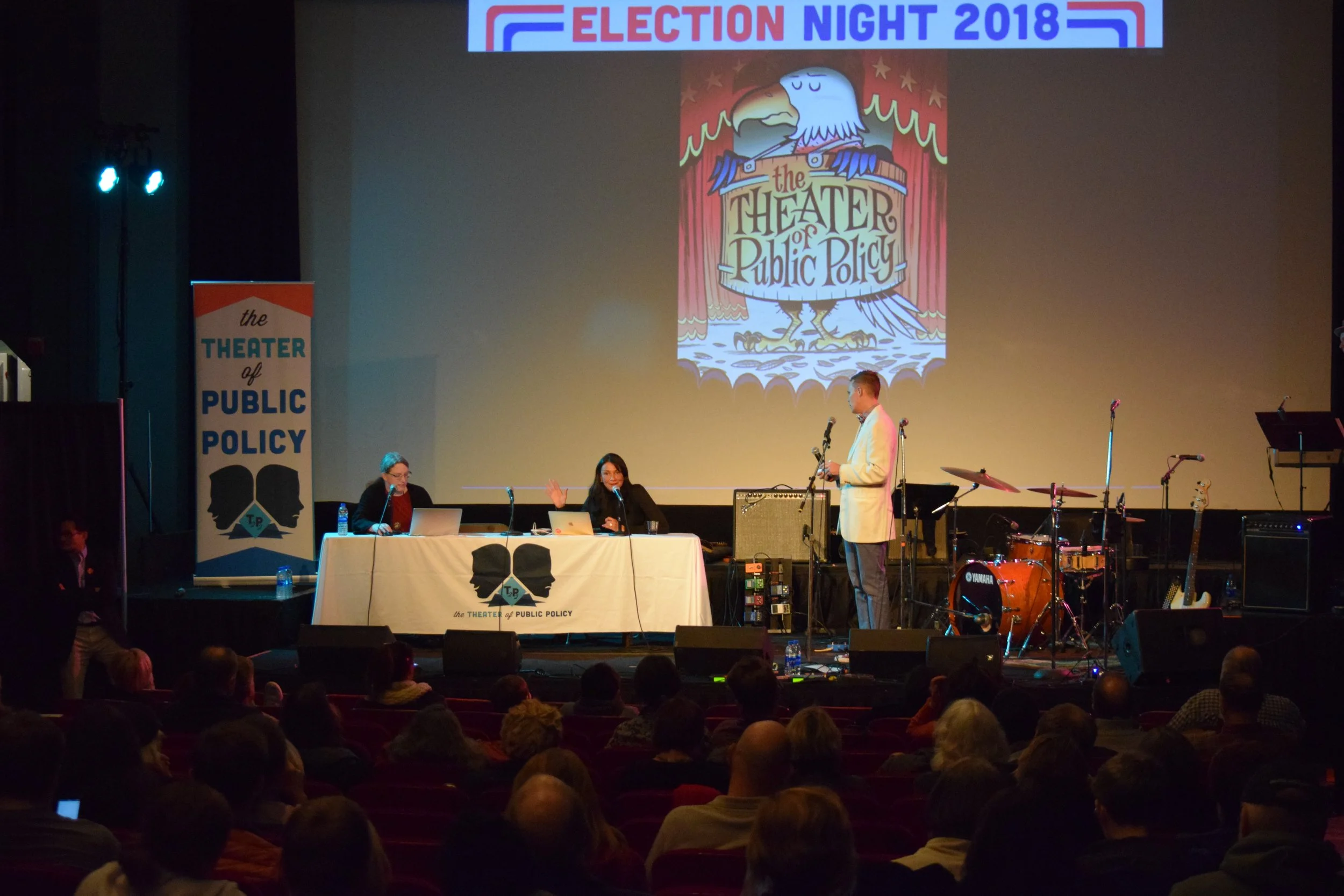
2018 Election Recap on The Theater of Public Policy.
Intro
Every The Theater of Public Policy show hinges on the right topic and the right guest. Though it’s an improv show at heart, we take our comedy seriously.
We’ve created internal guides to help our team consistently pick guests and issues that educate, spark genuine comedy, and bring new audiences into complicated debates. To celebrate our 15th year of T2P2, we’re giving you a peek behind the curtain into what we think makes a good topic and guest.
Plus, if you’re reading this, who knows? Maybe you could be our next onstage expert…
What is the show?
The Theater of Public Policy started performing in 2011 at HUGE Theater in Minneapolis. Every show features a smart interview with an expert or panel about an important issue. During that conversation, a team of improv performers are listening in to absorb the details of the talk.
After 25-30 minutes of discussion, the improvisers take the stage and bring everything to life. They explore the in’s and out’s, take arguments to their logical conclusion, and spin ideas on their head with hilarious interpretations. Then, we bring the guest expert back and take questions from the audience. Shortly after, we return for a final round of improv based on the audience Q&A. It’s all wrapped together in a quick 90 minutes.
Here’s a short video that explains the format:

What Makes a Great Topic
A great Theater of Public Policy topic has enough tension, specificity, and humanity to sustain both a thoughtful interview and a compelling comedy show. Everyone loves tater tot hot dish. It sounds like a funny combination of words. But that does not mean The Tater Tot Hot Dish Show would be very fun to watch.
Nuance
The strongest topics have genuine nuance. There are multiple sides, competing values, and no obvious answer that can be neatly resolved in an hour. They often sit at the intersection of several forces—science and ethics, identity and economics, personal experience and government policy. That complexity gives the conversation somewhere to go. It’s the difference between thin soup and a meal with something to chew on. We want our comedy to be like gristle. Wait, no, that’s gross. Abandon metaphor!
Context
Timing matters, too. A topic should feel relevant to what people are hearing in the news, discussing at work, or experiencing in their communities. Hot button issues can sometimes be surrounded by bad public conversations and while we want to combat that with dialogue, nuance, and humor, we also don’t want insert ourselves where we would be unwelcome.
Improv-ability
For our performers, the best topics also have people inside them. We look for issues that generate stories rather than only statistics or technical language. A promising topic comes with a cast of built-in characters: officials, residents, experts, skeptics, advocates, bureaucrats, neighbors, and the people directly living with the consequences. It often has a specific setting, too—a city hall, clinic, classroom, courtroom, boardroom, farm, or transit station—where the larger issue becomes visible in ordinary interactions.
Perspective
We are especially drawn to subjects that many people have feelings about but few deeply understand. A strong show can take that familiarity and turn it into curiosity. It might offer a fresh perspective on an established debate, introduce an idea that has not yet entered the mainstream, or reveal that something people thought was simple is actually far more interesting than it first appeared.
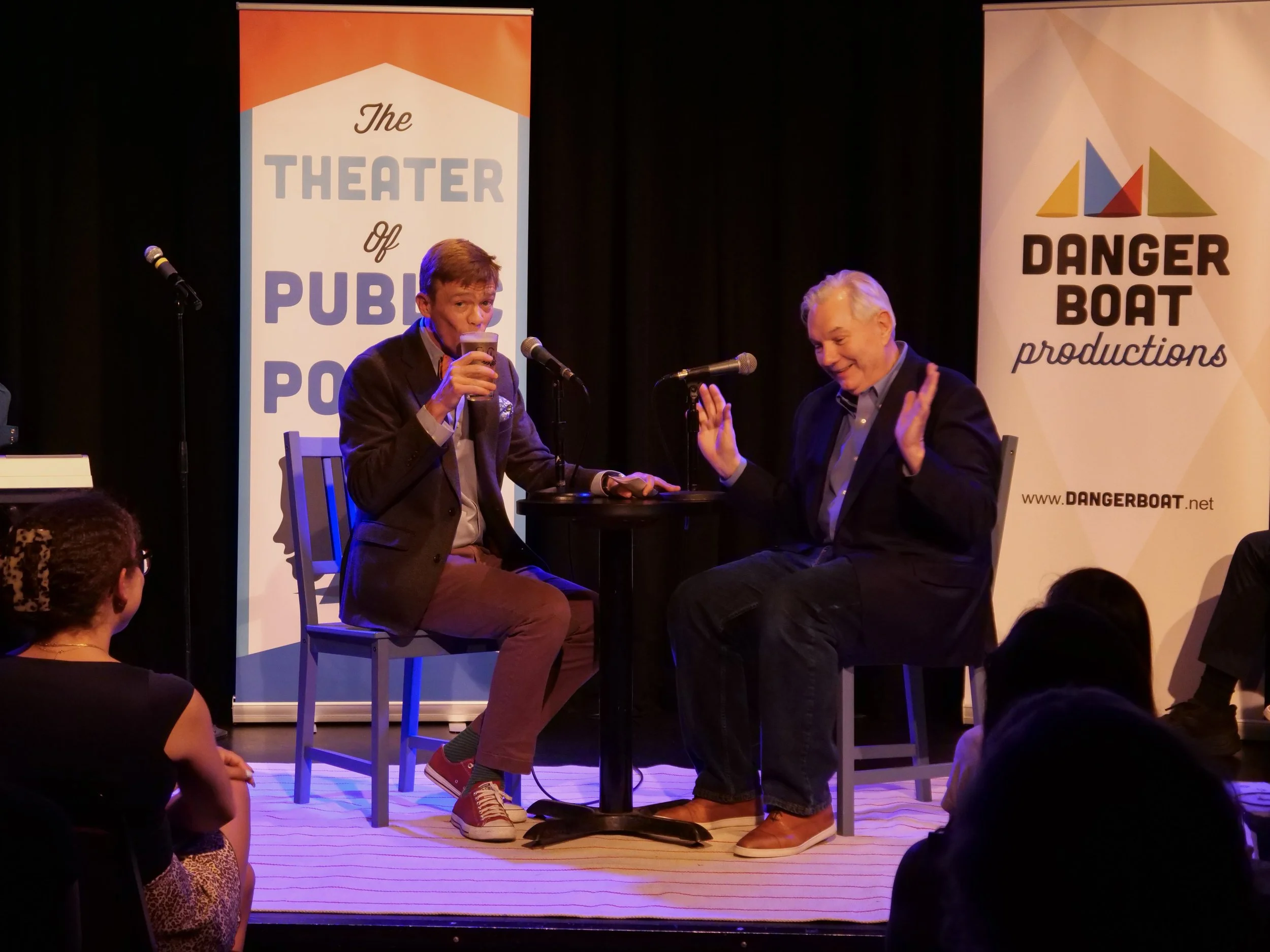
Dr. Michael Osterholm on The Theater of Public Policy (07/28/2026).
What Makes a Great Guest
Translatability
A great guest for The Theater of Public Policy knows their subject deeply but does not make the audience work to understand why it matters. They can speak with authority while translating technical ideas, professional language, and complicated systems into something a non-expert can follow. Expertise is valuable, but the ability to share it clearly is what makes it engaging.
Point of View
The strongest guests bring more than facts and prepared talking points. They have specific stories—something they witnessed, experienced, built, challenged, or learned firsthand. Those details give the audience a way into the issue and give our performers people, relationships, settings, and moments they can bring to life onstage. It wouldn’t work if a guest is recounting a podcast they listened to.
Flexibility
We also look for guests who are comfortable with the unexpected. The conversation may take an unplanned turn, the audience may raise a surprising question, and the improv will inevitably interpret the subject in ways no one could predict. A good guest can laugh, remain curious, and participate without needing to control the narrative. Guests that struggle coming on our show often tightly grip a powerpoint and believe that an audience is missing out if they can’t see their raw data set.
Identity
Guest selection also shapes who feels welcomed into the room. We consider race, gender, age, geography, professional background, and lived experience so that the people onstage reflect both the audience and the communities most affected by the topic. No single guest can represent an entire group, but the voices we invite signal whose knowledge and experiences we believe matter.
Dimension
Finally, a great guest does not simply tell the audience what it already believes. They offer a perspective that complicates the discussion, challenges assumptions, or introduces something the room may not have considered. The goal is not provocation for its own sake. It is to create the productive surprise that makes people lean forward, reconsider what they know, and leave with better questions than the ones they brought. People don’t need a comedy show to confirm what they already know.
Topic and Guest Rubric
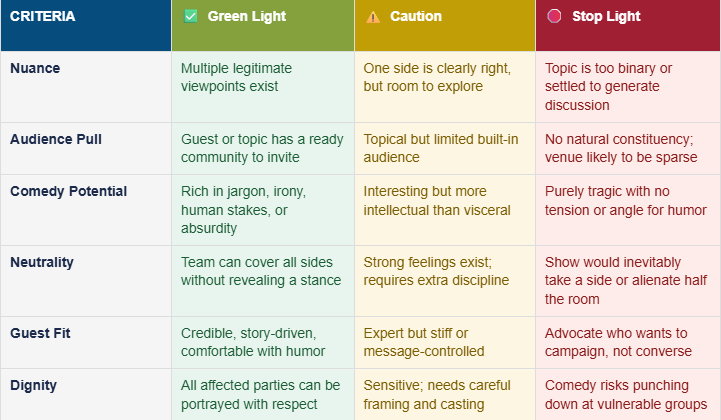
Why it Matters for the Improv
Aside from our own moral and political ethos, using these criteria to choose guests and topics is what makes for good comedy. Improv thrives on tension, ambiguity, and human stakes. The cast is processing information live—alongside the audience—so the richer the material, the better the performance. "Punching up" is always the goal: humor should land on powerful systems and institutions, never on those who are marginalized or most affected. Issues that feel heavy or uncomfortable are often the best fodder, because the vulnerability of grappling with hard things in public is itself funny and compelling.
Red Flags
Not every important issue is a good fit for The Theater of Public Policy. Some topics may be worthy of serious public attention, but do not create the conditions for the kind of curious, humane, and playful exploration our format requires.
Timing also matters. Some events are simply too raw. In the immediate aftermath of a tragedy, public trauma, or unfolding scandal, people may still be grieving, afraid, or waiting for basic facts to emerge. Humor can eventually help communities process difficult experiences, but using it too soon may feel less like perspective and more like disrespect.
We also try to avoid hyper-partisan electoral subjects and guests when the show could reasonably be understood as supporting or opposing a particular candidate or political party. Public policy is inherently political, and our guests often disagree strongly. But the purpose of the show is to explore ideas, systems, and consequences. If it comes off as a campaign rally, we think that isn’t informative or interesting. (Offense intended for campaign rallies.)
Conclusion
At the end of the day, is our comedy show going to change the course of major policy? Maybe not, but we see ourselves as one component of the civic dialogue space. Whether it’s letters to the editor, podcasts, political chat shows, or community meetings, we see ourselves as part of an ecosystem that lets the public engage with issues and ideas. Compared to our peers, we offer something different. Not that letters to the editor aren’t fun (they’re not), but you know what we mean.
We hope that you have a better understanding of how we choose our topics and guests and the effort that goes into developing a season of shows.If you read this whole article and think you would be a good fit for our show (or know someone who might), we'd love to hear from you. Reach out to info@dangerboat.net to learn more.
