
How People Find Local Events: Lessons from the Sketches of Minnesota Tour

How People Find Local Events: Lessons from the Sketches of Minnesota Tour
This is part of a series analyzing survey data from Sketches of Minnesota tour in 2025.
What is Sketches of Minnesota?
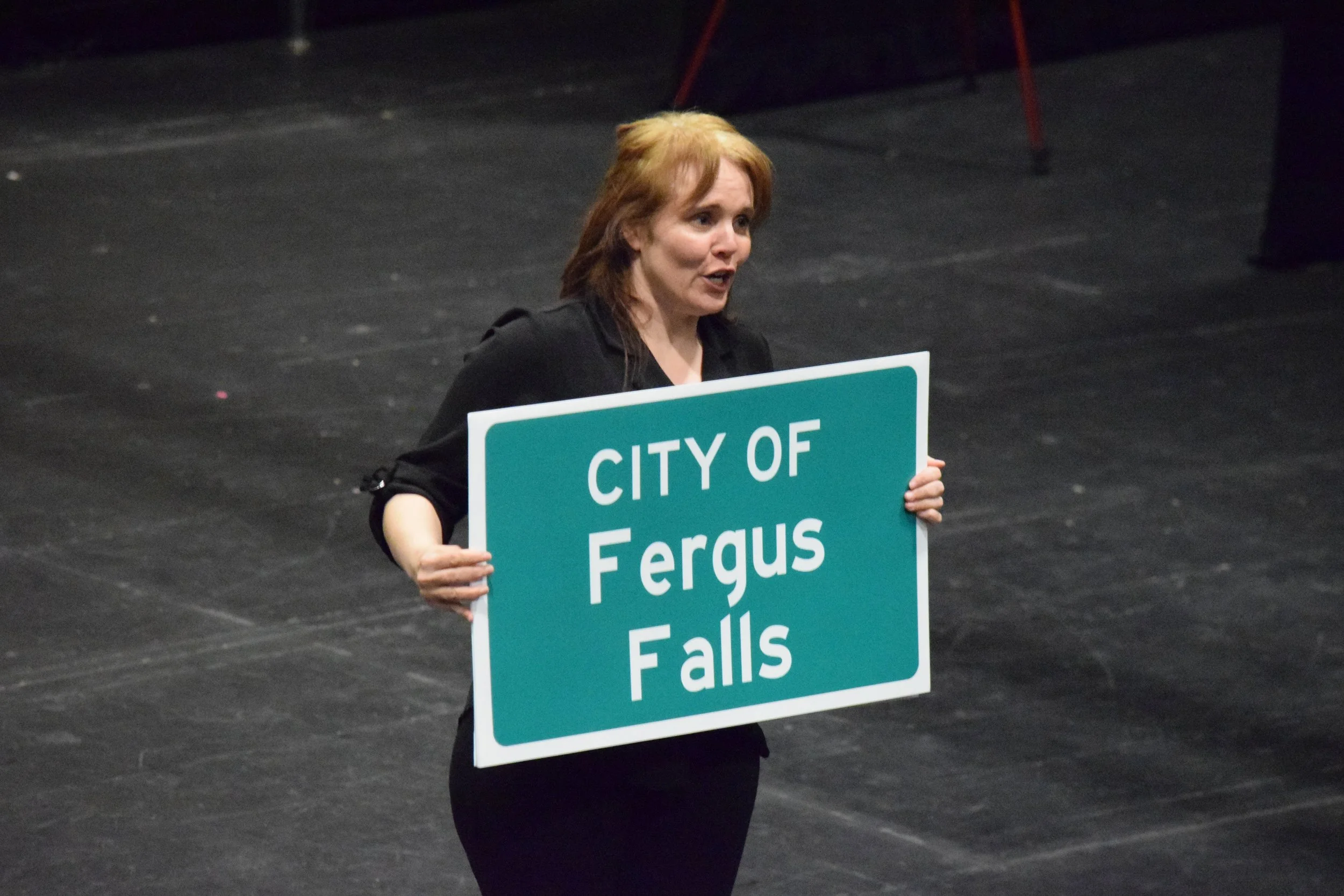
Sketches of Minnesota is a community-inspired civic improv comedy tour created by Danger Boat Productions in partnership with the Minnesota Humanities Center. In 2025, we visited nine locations: Braham, New Ulm, Rochester, Kingfield, Rosemount, Fergus Falls, Bigfork, Fosston, and New York Mills.
At every location, we partnered with one or multiple “host organizations” that helped us on the ground with planning. They may have been a local nonprofit, government organization, or just a group of local citizens that helped put on the event.
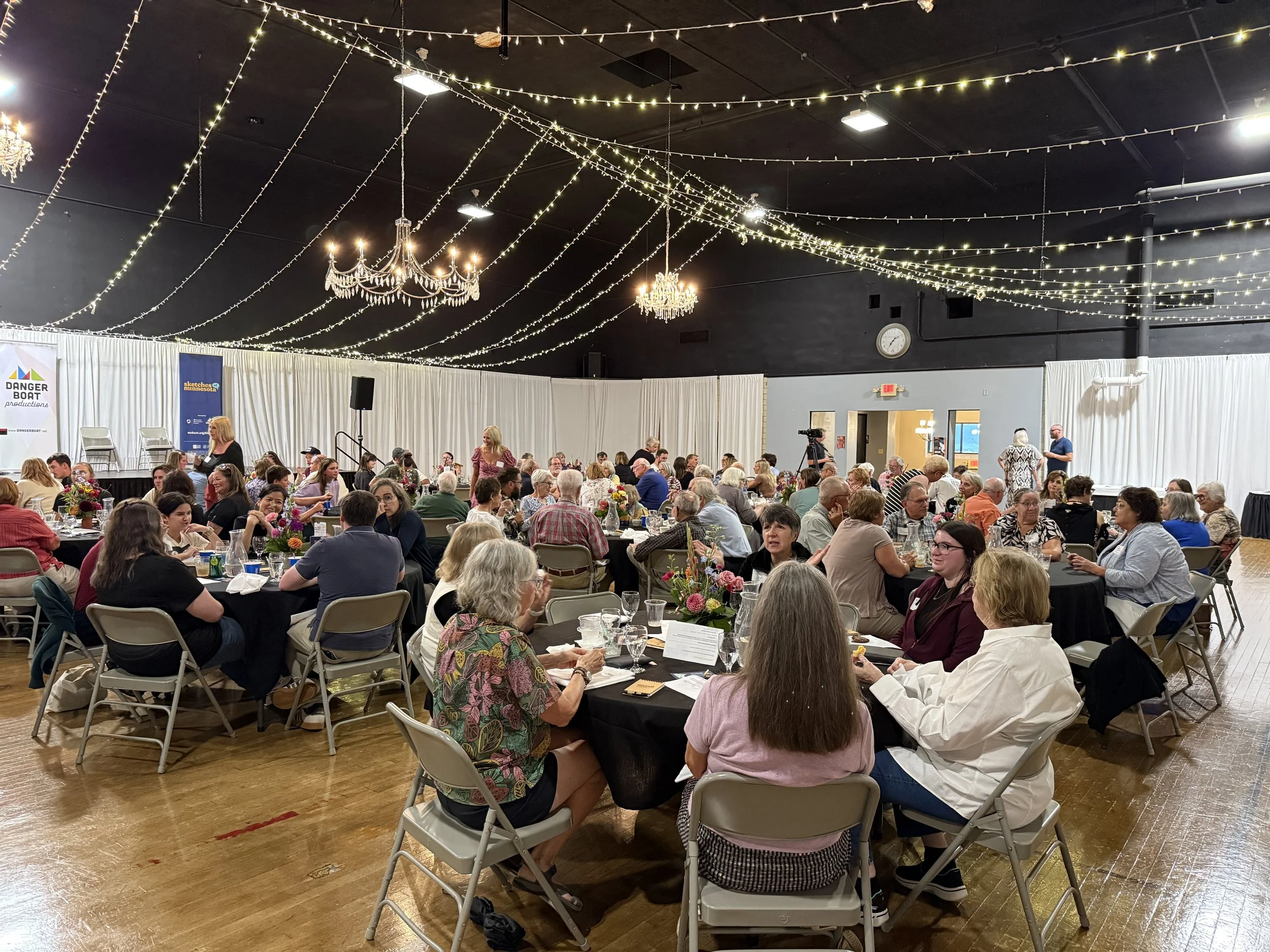
At each event, community members gathered for a shared meal and conversation about their town. Then, our team of improvisers turned what they heard into a live comedy show reflecting the stories, points of pride, challenges, and hopes of that community.
Our Approach
We tried a bunch of different marketing methods to draw attendees to these shows. At each event, we placed paper surveys on the tables at our events and asked attendees to fill them out at the end. One question asked:
How did you find out about the event? (Circle all that apply).
The answer options were: Word of mouth, Connected to Host Org, Poster/Flyer, Email/Newsletter, TV/Radio/Newspaper, Community Calendar, Someone Brought Me, Social Media, Website, and Other.

In marketing terms, your main forms of audience outreach fall into internal audiences and external audiences.
Internal audiences refers to people that have opted-in and are already connected to you in some way. This includes Word of Mouth, Email/Newsletter, Someone Brought Me, Social Media, and Connected to Host Organization.
External audiences are those outside of your communication reach, those that may be hearing about you for the first time. These categories include Poster/Flyer, Community Calendar, and TV/Radio/Newspaper, and some social media.
Survey Results
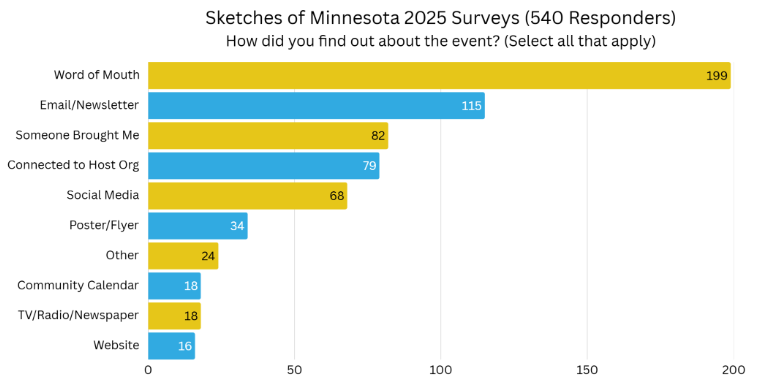
At the end of the event, we collected all of the surveys and entered the results into Google sheets. We received 538 responses across 9 events with estimates of total attendance around 1,000.
Our results:
Word of Mouth: 199
Email/Newsletter: 115
Someone Brought Me: 82
Connected to Host Org: 79
Social Media: 68
Poster/Flyer: 34
Other: 24
Community Calendar: 18
TV/Radio/Newspaper: 18
Website: 16
1) Word of Mouth
Unsurprisingly, word of mouth was the strongest driver of attendance.
People are more likely to attend an event when they hear about it from someone they know and trust. For community-based programming, personal invitations matter.
This is especially true for events that are new, unusual, or hard to explain in a single sentence (like Sketches of Minnesota). A poster can tell someone what time the event starts. A friend can say, “No really, this is going to be fun. You should come with me.”
For future events, this suggests that host partners in each community should not only promote the event broadly, but also think intentionally about who can personally invite others. Could we create a script or elevator pitch to help with talking points? Would it be useful for us to create a postcard or business card that serves as a physical reminder that people can take with them?
2) Email/Newsletter
Email and newsletter outreach was the second strongest source of attendance.
These responses likely represent invitations or organizational newsletters sent to people already connected to a host organization or partner.
In our promotional kit that we sent to each host partner, we provided a complete email template to promote the event. This was especially useful for organizations that don’t regularly write event promotions from scratch. However, because a template can sound inauthentic if it comes off as too generic or unlike the sender’s usual voice, we encouraged partners to adapt the language and make it their own.
The advantage of this type of marketing is that it gives audiences a direct path to more information. A good email can send someone to the event page, registration form, photos from past events, and background on the project.
The limitation is that email usually reaches people already inside an organization’s network. Unless it is forwarded or shared widely, it is not the best tool for reaching brand-new audiences.
3) Someone Brought Me
This category is more important than it might look at first glance.
Someone who selected “Someone Brought Me” may not have seen the poster, read the email, or heard the radio interview. They attended because another person wanted them there.
That matters. For many people, the biggest barrier to attending an arts or community event is not a lack of interest — it is uncertainty. Will I know anyone? Will this be awkward? Is this really for me?
A personal invitation lowers that barrier. It turns an unknown event into a shared experience.
There is also research from the National Endowment for the Arts showing that attending with another person is one of the major reasons people choose to participate in arts events. (Source: “Arts Participation Patterns in 2022: Highlights from the Survey of Public Participation in the Arts.”)
For future outreach, this suggests a simple strategy: don’t just ask people to attend. Ask them to bring someone.
4) Social Media
Social media helped, but it’s not the magic turnout machine people sometimes hope it will be.
In our experience, converting social media views into actual event attendance takes a lot of effort. A post can get likes, shares, and comments without necessarily moving people to leave their house and show up in person.
Most organizations are likely to have a strong Facebook presence, but struggle with Instagram, X, Threads, Linkedin, TikTok and other platforms. Media-heavy platforms require time, design skills, video editing and regular posting that is often beyond the abilities of smaller organizations.
Social media audiences also tend to skew older, which is good news because those folks are likely to attend in person events. But if you’re looking for audiences under 30 years old, you’ll need to try different approaches.
To help organizations hosting our show, we created a 1-minute video that provided an overview of the entire event with footage from past events. We customized the banner and closing information for each location and gave them a separate YouTube link and download link that they could post themselves. We don’t know exactly how these videos were used by everyone, but across all of our YouTube hosted videos, we had under 100 total views.
In theory, a widely shared post can reach external audiences. In practice, social media often works best when it supports other outreach rather than replacing it.
5) Poster/Flyer
Posters and flyers played a smaller but still useful role.
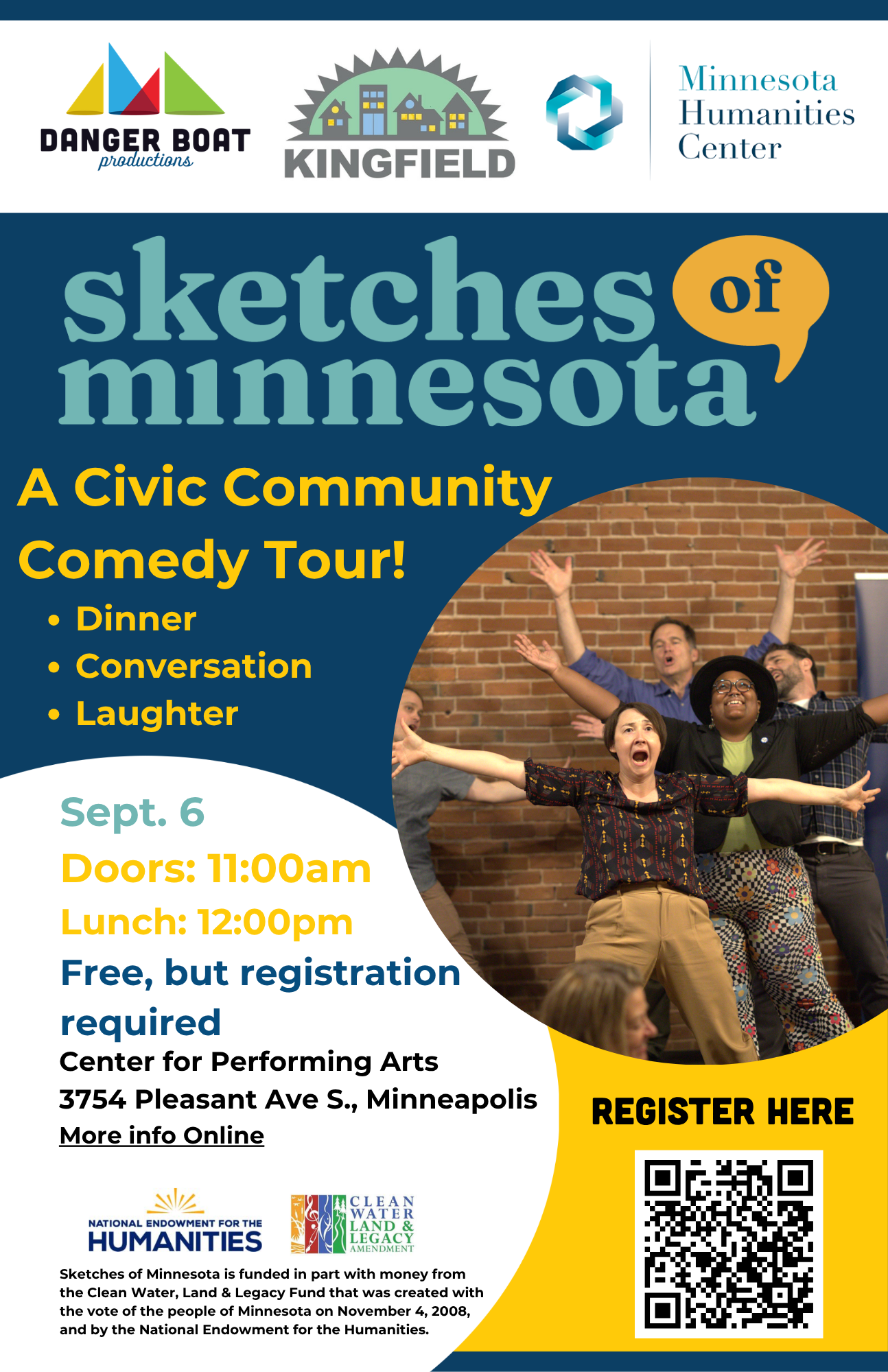
For the tour, we created two poster template posters for our partners: one sized 8.5x11 and the other 11x17. We did this for two reasons. First, it saved time by allowing our team to create one strong design for multiple communities. Second, it maintained consistent branding across the tour.
In a few cases, partners asked to customize the posters. Sometimes edits created design challenges. Logos did not always fit well in the template, additional text made the poster crowded, or the final version lost some of the visual clarity of the original design.
Whether those changes affected attendance is hard to know.
To truly understand the efficacy of the posters, we would need to ask partner organizations how many were printed, where they were placed, and what type of location they appeared in (coffee shop, bar, church, etc.). That would help estimate exposure, but this level of tracking might be burdensome on the host partner.
The takeaway: posters are useful, but they work best as part of a broader strategy.
6) Other
The “Other” category captured responses that didn’t fit our options.
Sometimes people would write something that could be recategorized. For example, if someone wrote “wife”, we counted that as "Someone Brought Me.” Other answers were less clear, such as “School Board”.
While this category was small, it did provide us with additional outreach possibilities. “School Board” is not a full strategy, but it suggests that civic groups, local boards, schools, churches, clubs, and community organizations can be powerful messengers.
For future events, it may be worth identifying a few local “community connectors” who can share the event through their own networks.
7) Community Calendar
Community calendars are printed or digital schedules of events and goings on.
In smaller communities, there may only be one or two central calendars where people look for what is happening in town. These calendars might include everything from city meetings and school concerts to pancake breakfasts and summer festivals.
Community calendars did not drive a huge number of responses, but they are still worth using. They are usually free, relatively easy to submit to, and help establish that the event is part of the local civic and cultural landscape.
They probably will not carry the full weight of promotion, but they are a low-cost outreach tool that can support the rest of the campaign.
8) Website
This category included Danger Boat’s Website, the Minnesota Humanities Center (MHC), and the website of the host community.
For Danger Boat, each event page was a funnel to the MHC registration page. We used cookie cutter pages that had lots of explanatory information about the project, who Danger Boat is, who MHC is, and then the show details of who, when, where.
Our website was likely not the first place that someone found out about the event. More likely, they encountered some other form of outreach, wanted to know more about our organization, and then did a search for us.
When people are deciding whether to attend, they may want to know who is behind the event, what will happen, whether it is really free, whether dinner is included, and whether the experience is meant for them.
We also received feedback from some communities that our event registration page was overwhelming. Because this is a grant-funded program, we needed to capture detailed demographic information for reporting purposes. However, we were told that some people in rural areas were deeply suspicious of turning over that amount of semi-private information to an organization based in the Twin Cities.
To ease these concerns, we offered to manually register people. That helped some attendees, but it also became time-consuming as more people requested assistance.
For future events, we may need to balance funder reporting needs with a simpler, more welcoming registration process.
9) TV/Radio/Newspaper
Mass media had the widest reach, but had one of the smallest impacts on attendance.
Tour coverage of the tour included: 7 television appearances, 7 radio stories, 4 newspaper articles, 2 online only-articles, and 2 podcast appearances.
That sounds like a major promotion win, and in many ways, it was. Media coverage builds credibility, raises awareness, and helps tell the story of a project to a much wider audience.
But based on surveys, it did not appear to be a major driver of attendance.
When people encounter you in mass media, they may be washing dishes, commuting, or folding laundry. You’re also wedged between congressional news, a local dog that walks on its hind legs, or a train derailment. It’s not always the best environment for moving someone from awareness to action.
That doesn’t mean media coverage is useless. It can build prestige, give credibility, help funders and partners see momentum, and help with long-term awareness. But if the goal is immediate event turnout, it should not be the only strategy.
Conclusion
The biggest lesson from this data is simple: people show up because of people.
Word of mouth, personal invitations, newsletters, host organization connections, and “someone brought me” were the strongest drivers of attendance. The more personal the outreach, the more effective it seemed to be.
For future events, we would focus less on trying to reach everyone and more on helping the right people invite their people. That means equipping host partners with clear language, easy-to-share materials, and specific asks: invite a friend, forward this email, bring someone with you, and personally reach out to people who should be in the room.
Big visibility is helpful. But for community events, trust is the real marketing channel.