
What Happens When a Town Sees Itself Reflected Back Through Comedy?
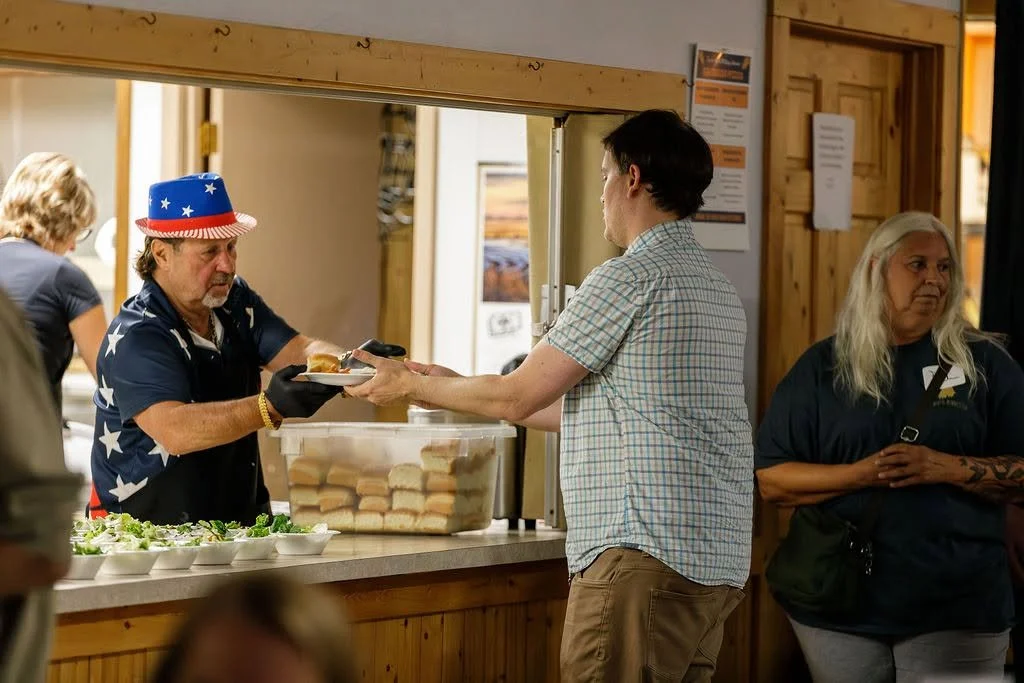
Food is passed out at the 2026 Sketches of Minnesota show in Montevideo.
What Happens When a Town Sees Itself Reflected Back Through Comedy?
Americans are not short on opportunities to disagree. What we are often missing are places where disagreement can feel welcoming, constructive, and even enjoyable.
Too many civic events begin with an assumption of obligation: people should attend because the issue is important, because participation is their responsibility, or because the community needs their input.
Sketches of Minnesota was created as a different kind of invitation. Through a free community meal, facilitated conversation, and an improv comedy performance inspired by what residents share, the program gives neighbors a chance to talk honestly about what they value, what concerns them, and what they hope their town might become.
But does making civic engagement more playful actually make it more meaningful?
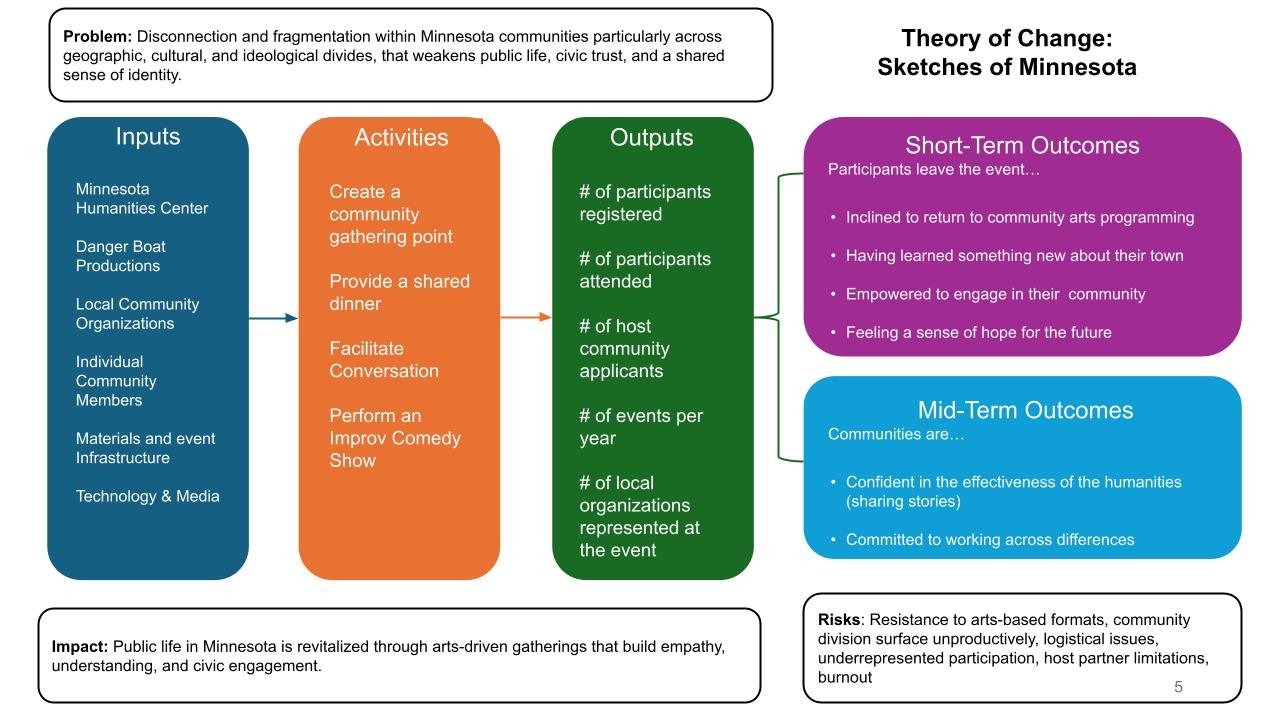
Credit: Jason Heaney, American University.
In 2024, Sketches of Minnesota was selected for a multi-month evaluation through a partnership between American University and the Federation of State Humanities Councils. Evaluator Jason Heaney examined hundreds of participant surveys, interviewed community partners, and spoke with Danger Boat performers and staff to understand whether the program was reaching its intended audiences, producing meaningful outcomes, and being implemented successfully.
The findings suggest that fun is not merely an added benefit of civic engagement. It’s one of the tools that makes deeper engagement possible.
What is Sketches of Minnesota?
Sketches of Minnesota is a partnership between Danger Boat Productions and the Minnesota Humanities Center (MHC). We work with local community partners of a Minnesota city to host an event that brings a community together for a free shared meal, facilitated conversation, and improv comedy show built from what residents share about their town.
Over dinner, we ask attendees to discuss with others at their tables:
What is something great about your town that people elsewhere might not know?
What do outsiders often get wrong about your community?
What divisions or conflicts concern you, and why?
What do you imagine for the future of this place?
Afterward, a team of improv performers from Danger Boat take the stage to bring those conversations to life through completely unscripted comedy theater. At a base level, the performance can be a funhouse mirror reflection of a community. But at its best, the comedy helps people move out of their comfort zone and experience deeper truths about what ties a community together.
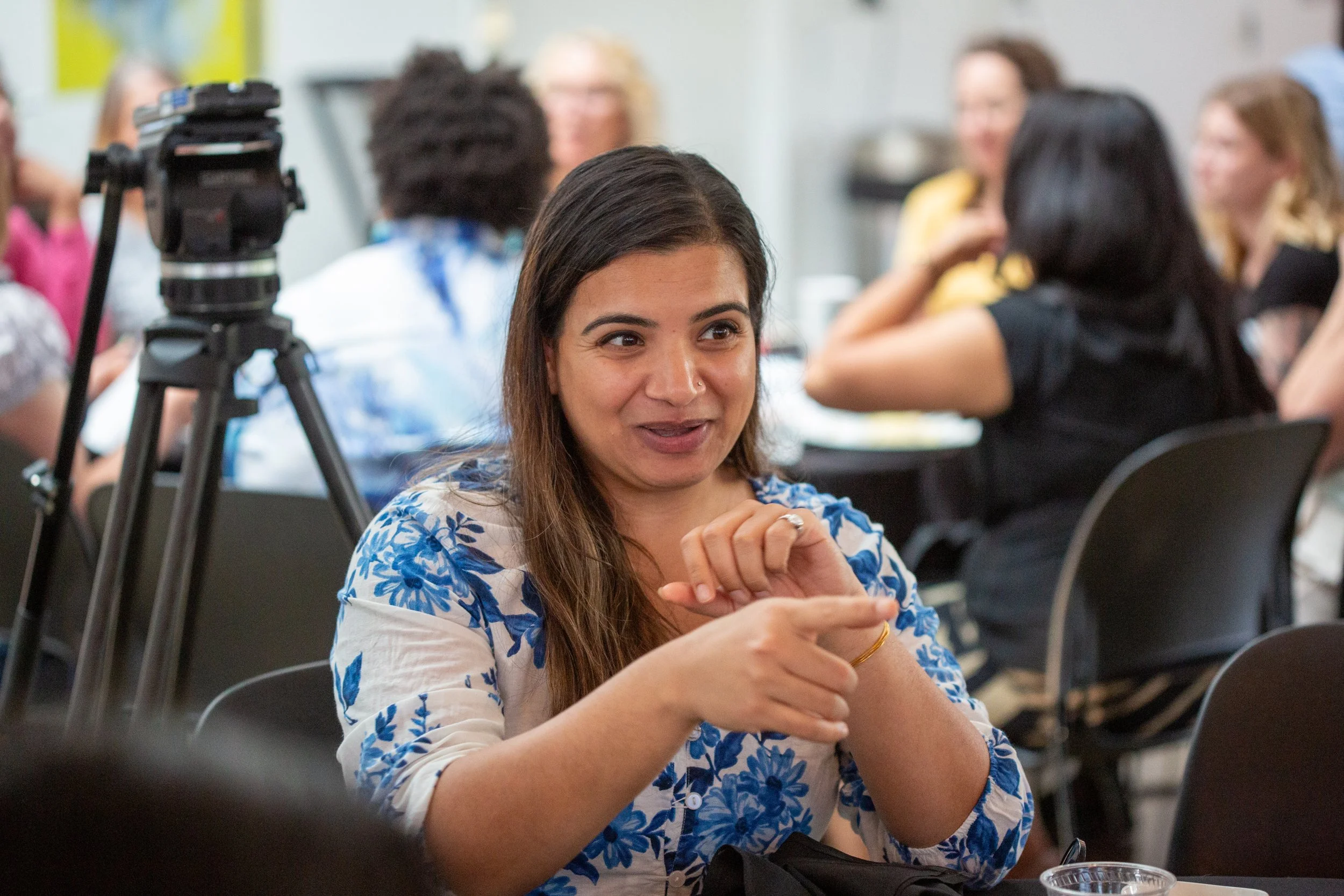
A community member shares with their table at the 2026 Sketches of Minnesota show in Rochester.
What did the evaluation look like?
In 2024, the same year we started Sketches, we wanted to know if it actually worked as a civic program. So Danger Boat and the Minnesota Humanities Center pitched Sketches of Minnesota to American University and the Federation of State Humanities Councils, who partnered to offer pro bono evaluations of national programs and their outcomes and impact.
American University's Evaluation Studies Department chose Sketches to be the subject of a year-long project for a student in their graduate program. Master's student Jason Heaney worked with us to take a closer look at Sketches: constructing an evaluation framework, carrying out analyses, and finally reporting back.
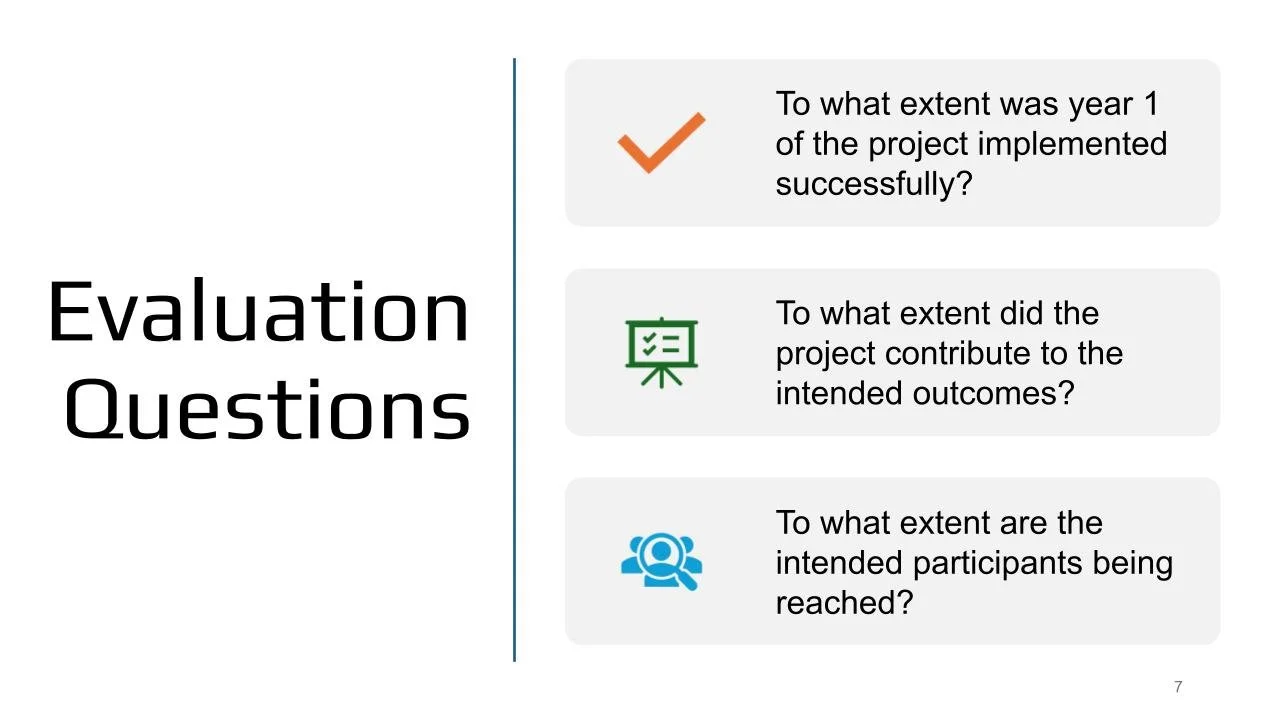
There were three questions driving this evaluation:
To what extent was year 1 of the project implemented successfully?
To what extent did the project contribute to the intended outcomes?
To what extent are the intended participants being reached?
Surveys
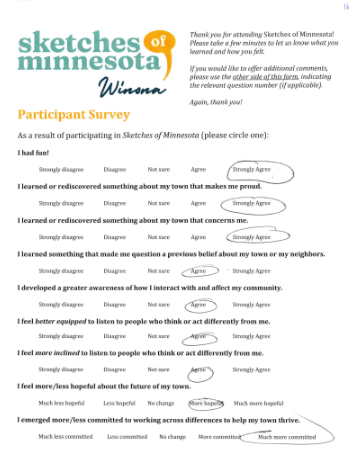
Jason analyzed post-event paper evaluations we collected at every stop. He analyzed 483 responses that we received from communities in Winona, West St. Paul, Duluth, Glencoe, Waite Park, Emily, Morris, Little Falls, Austin, and International Falls. We asked communities to rate how much they agreed with each statement on 1-5 scale:
I had fun!
I learned or rediscovered something about my town that makes me proud
I learned or rediscovered something about my town that concerns me
I learned something that made me question a previous belief about my town or my neighbors.
I developed a greater awareness of how I interact with and affect my community.
I feel better equipped to listen to people who think or act differently from me.
I feel more inclined to listen to people who think or act differently from me.
I feel more/less hopeful about the future of my town.
I emerged more/less committed to working across differences to help my town thrive.
Interviews
Jason also hosted several focus group discussions with DBP performers and staff, MHC staff, and community partners in the cities where shows took place. Following introductions and informed consent, he asked semi-structured interview questions crafted to align with project outcomes.
After Jason collected all of the data, he analyzed it and assembled it into a report and presentation for our team.
“There was vibrant conversation – people in the community want this!”
What did we learn?
97.5% rated “I had fun” as 4 or 5.
88.7% felt more inclined to listen to people who think or act differently.
87.5% felt more committed to working across differences.
82.7% felt more hopeful about their town’s future.
Overall: Fun lowers the barrier to civic engagement.
The first step in better civic conversation may not be changing people’s minds. It may be helping people recognize that their neighbors are worth listening to in the first place.
Sketches did not ask people to agree, but helped them practice the conditions for better disagreement: listening, curiosity, humor, and shared local pride. By making the room feel warm, playful, and low-stakes, Sketches helped people participate in conversations that might otherwise feel too awkward, abstract, or politically loaded.
This was especially true in smaller communities, where the event seemed to function as more than entertainment. In many cases, it became a temporary town square. Jason's evaluation of Sketches overall specifically recommends we continue to focus on smaller communities and, where possible, do programming more frequently in individual communities to keep these discussions going
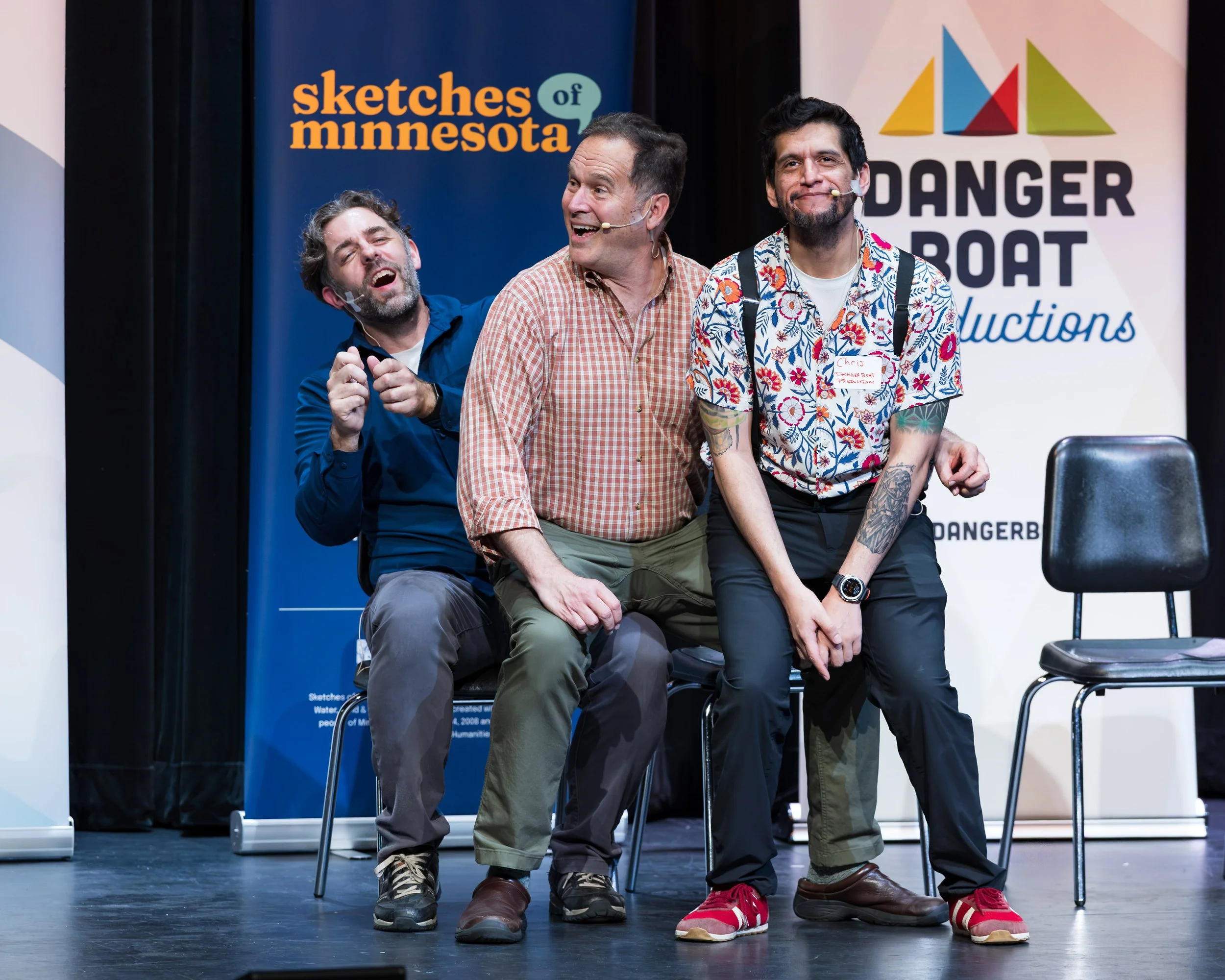
Danger Boat cast members (left to right) Michael Dallavalle, Jim Robinson, and Chris Rodriguez at the 2026 Sketches of Minnesota show in Big Fork.
What should we improve?
Jason’s recommendations to improve the program were:
Reach beyond arts-and-humanities audiences
Build more viewpoint diversity
Add follow-up evaluation
Create clearer “what now?” pathways
The project did well reaching historically underrepresented populations relative to host community goals, but ideological or viewpoint diversity was a more complicated challenge than demographic.
The recommendation was to continue supporting underrepresented participation while also reaching people not traditionally drawn to arts and humanities programming.
One of the clearest lessons from Year 1 is that inclusion has multiple dimensions. It is not enough to fill the room. The room also needs people who do not all arrive with the same assumptions about art, community, politics, or civic life.
“Looking back I’m left with the feeling that there is no reason to allow ourselves to be divided outside of a forum like Sketches.”
Closing
Sketches of Minnesota worked because it made civic conversation feel inviting instead of obligatory.
The biggest lesson from Sketches of Minnesota is that people are willing to have meaningful conversations about their communities when the invitation feels human. A shared meal helps. A good prompt helps. And yes, a room full of improvisers turning local stories into comedy definitely helps.
At its best, Sketches does not tell a community who it is. It listens closely, reflects people back to one another, and creates a joyful space where neighbors can laugh, recognize shared concerns, and imagine what they might do next.
For organizations trying to bring people together around complex topics, that may be the real takeaway: engagement works better when people feel seen, heard, and glad they came.
