
Why Did We Decide to Hire a Full-Time Team?

Danger Boat Staff [From left to right: Tane Danger (Co-founder), Brian Gioielli (Production Manager), Casey Baker (Production Manager), Clay Smith (Marketing Manager), and Brandon Boat (Co-founder)]
Why Did We Decide to Hire a Full-Time Team?
by Brandon Boat, co-founder of Danger Boat Productions | 15 min read
Introduction
Last year, Danger Boat Productions hired our first full-time employee (Brian Gioielli).
We liked it so much that we did it three more times.
That brought our team to six people, which feels both exciting and slightly terrifying in the way all meaningful business milestones do. For most of Danger Boat’s life, Tane and I (Brandon) operated as the classic small-business/founder duo: doing the work, selling the work, managing the work, inventing systems for the work, forgetting where we put the systems, and then reinventing them under a deadline.
We’ve worked with over half a dozen contractors over the years and while we liked their work, we needed a bigger change.
We needed to get much clearer about what our business actually needs, what work belongs with which role, and what kind of company we want Danger Boat to become. I wanted to write about that because hiring your first team members isn’t easy and involves long metaphorical gazes into a mirror.
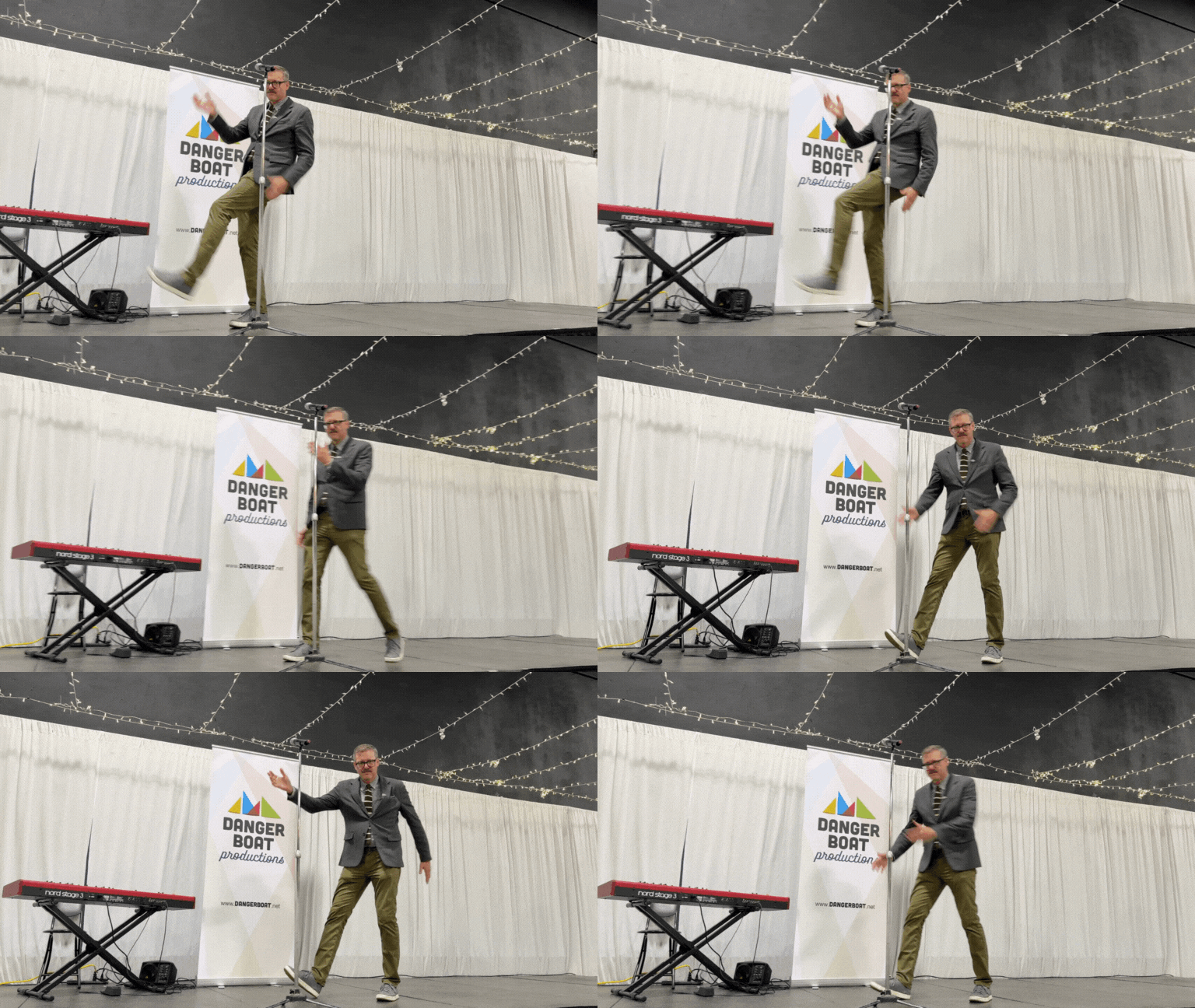
Our first Production Manager, Brian Gioielli, at a Sketches of Minnesota event.
Why did we need to hire people?
Like much of the world, Danger Boat took a hiatus in 2020. Since restarting the business in earnest in 2023, the organization has seen a lot of incredible growth in both volume and number of engagements that we work on. We had reached the limits of our capacity to take on new clients and projects. In order to continue to grow the business, we needed to bring on more hands to help us deliver excellent results in our work.
Another key consideration was clarity.
For 15 years, we primarily operated as small business owners and wore dozens of different hats. If something needed to happen, one of us figured out how to do it. It worked until it didn’t. It led to a lot of institutional knowledge living in our heads or having to rebuild a bicycle every time we needed to go for a ride.
It also gave us the chance to hire people who are better than we are at specific kinds of work. That might sound obvious, but it’s a major mental hurdle for founders. The goal wasn’t simply to hire ourselves out of doing certain types of tasks, but hire people that can take ownership of work, improve it, and bring energy to things that would otherwise be done late, rushed, or made out of spite. And good work isn’t made out of spite; it’s made with love.
Why not contractors?
For most of Danger Boat’s history, we relied heavily on contractors. That made sense for a long time.
Contractors can offer flexibility for both sides. They can be easier to scale up or down depending on workload. They usually require less infrastructure, less management, and fewer fixed costs. You are not necessarily providing office space, technology, payroll services, benefits, or the same level of ongoing administrative support.
There is a reason small businesses use contractors. Contractors are useful. We still use contractors. Some of our favorite people are contractors. (Contractors: It’s not you, it’s us.)
But, we also started to notice the limits of that model.
Contractors have multiple clients, multiple deadlines, and multiple priorities. Even when they care deeply about your work, your project may still be the fifth most urgent thing on their plate. That can be completely reasonable on their end and still hard on yours.
We wanted people who could devote more consistent attention to the business. We wanted team members who could understand the whole arc of a project, help improve systems over time, and take ownership of an area of work rather than simply complete assigned tasks.
There is also a predictability that comes with employees. It is easier to plan projects, schedule meetings, and build systems when someone has dedicated time with the company. It is harder when a contractor decides to work from Greece for the summer. (Which to be fair, sounds lovely, but does complicate weekly meetings.)
The tradeoff is that employees require more infrastructure. Payroll, taxes, management, insurance, benefits, onboarding, supervision, communication, and culture all become part of the job. Hiring employees didn’t make the business simpler, but did expand the entire potential of everything we do.
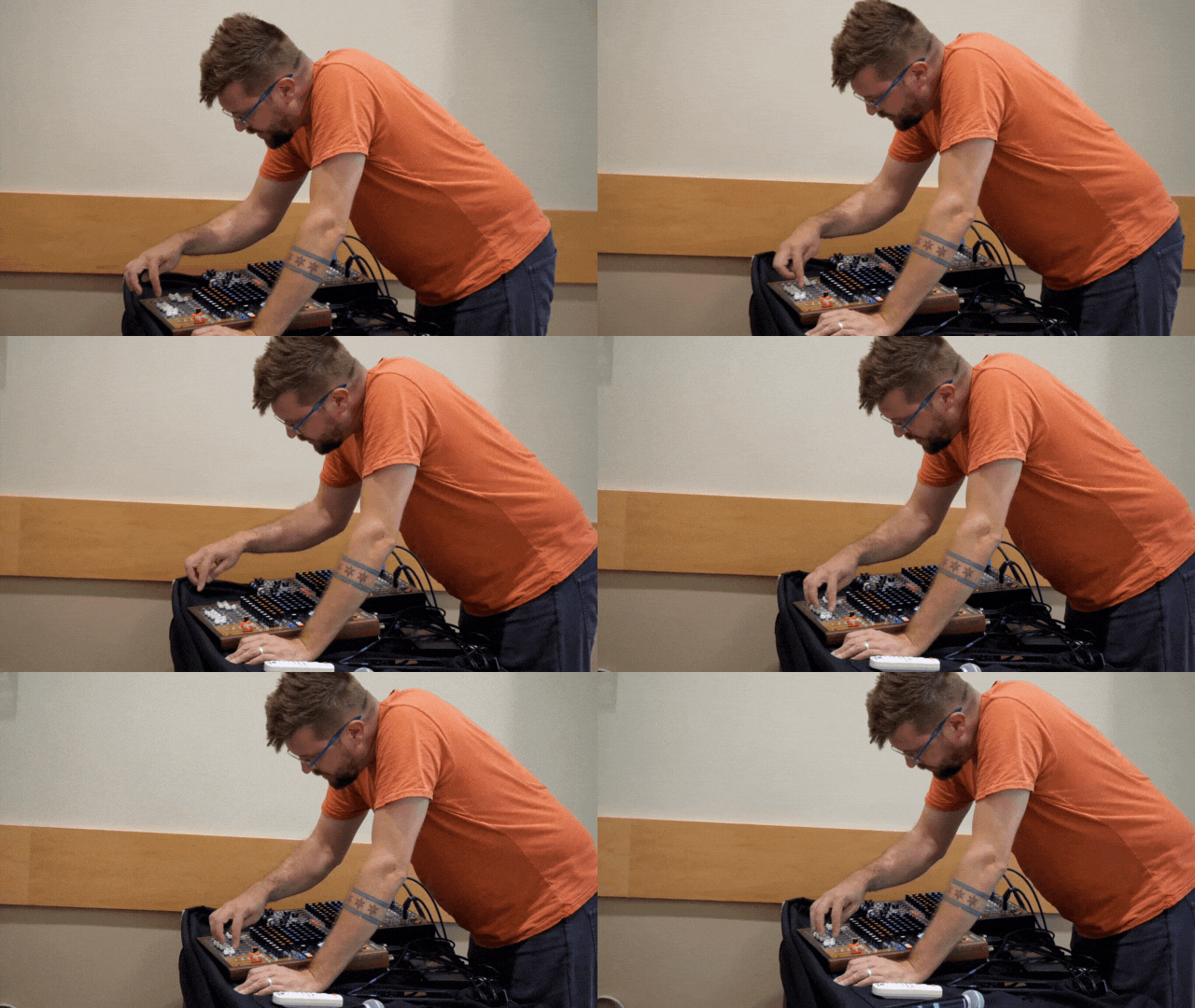
Newest Production Manager, Casey Baker, attending to audio needs at a Sketches of Minnesota event.
How we figured out which roles to hire
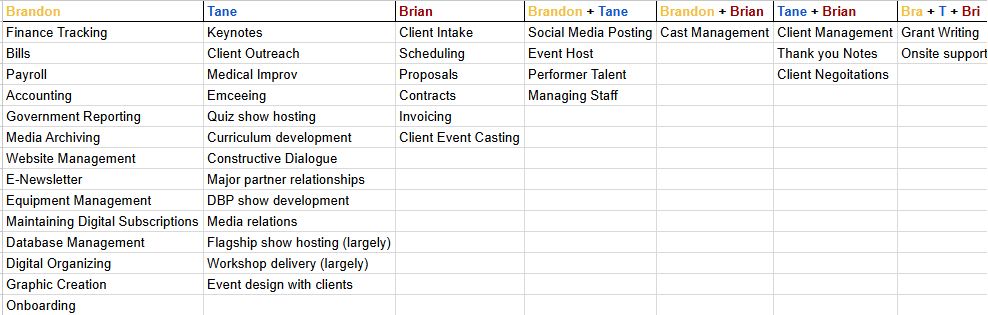
In order to get clarity on the right roles we needed to hire, I listed every person currently involved in the business and wrote down the responsibilities they carried. For any task that had joint ownership or may be done by more than one person, I created separate columns with both people’s names. At the end of that process, our spreadsheet looked something like this:
Then, I cut and pasted some of the responsibilities we were looking to offload — and new responsibilities we didn't yet have capacity for — into new columns until I had a full job description's worth of tasks. That left us with the roles of Production Manager, Marketing Manager, and Administrative Assistant.
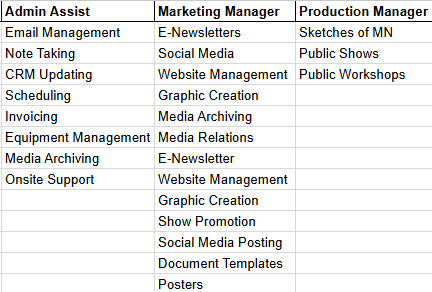
Production Manager
A Production Manager was needed because live events have a lot of moving pieces, and those details matter. Our work involves clients, venues, performers, tech needs, schedules, run-of-show documents, and plenty of last-minute logistics. The Production Manager helps plan and execute shows, workshops, and client events so that our team can walk into the room prepared, organized, and ready to do great work.
In caveman speak, “NEED MAKE GOOD SHOW.”
Marketing Manager
A Marketing Manager was sorely needed because Danger Boat has two different audiences: organizations that might hire us, and people who might attend our public events. That means we need someone who can help explain what we do through proposals, sell sheets, website copy, email campaigns, social media, and event promotion. Their work helps make sure our shows, workshops, and services are clear, compelling and easy for people to understand.
In caveman speak, “NEED PEOPLE SEE SHOW.”
Administrative Assistant
An Administrative Assistant was vital, because growth creates a lot of small-but-essential tasks that cannot keep living in the founders’ heads. Scheduling, follow-up, documentation, invoices, contracts, data entry, and internal organization all need consistent attention. This role helps create order, keep projects moving, and turn “we should deal with that” into “that has been handled.”
In caveman speak, “NEED HELP!”
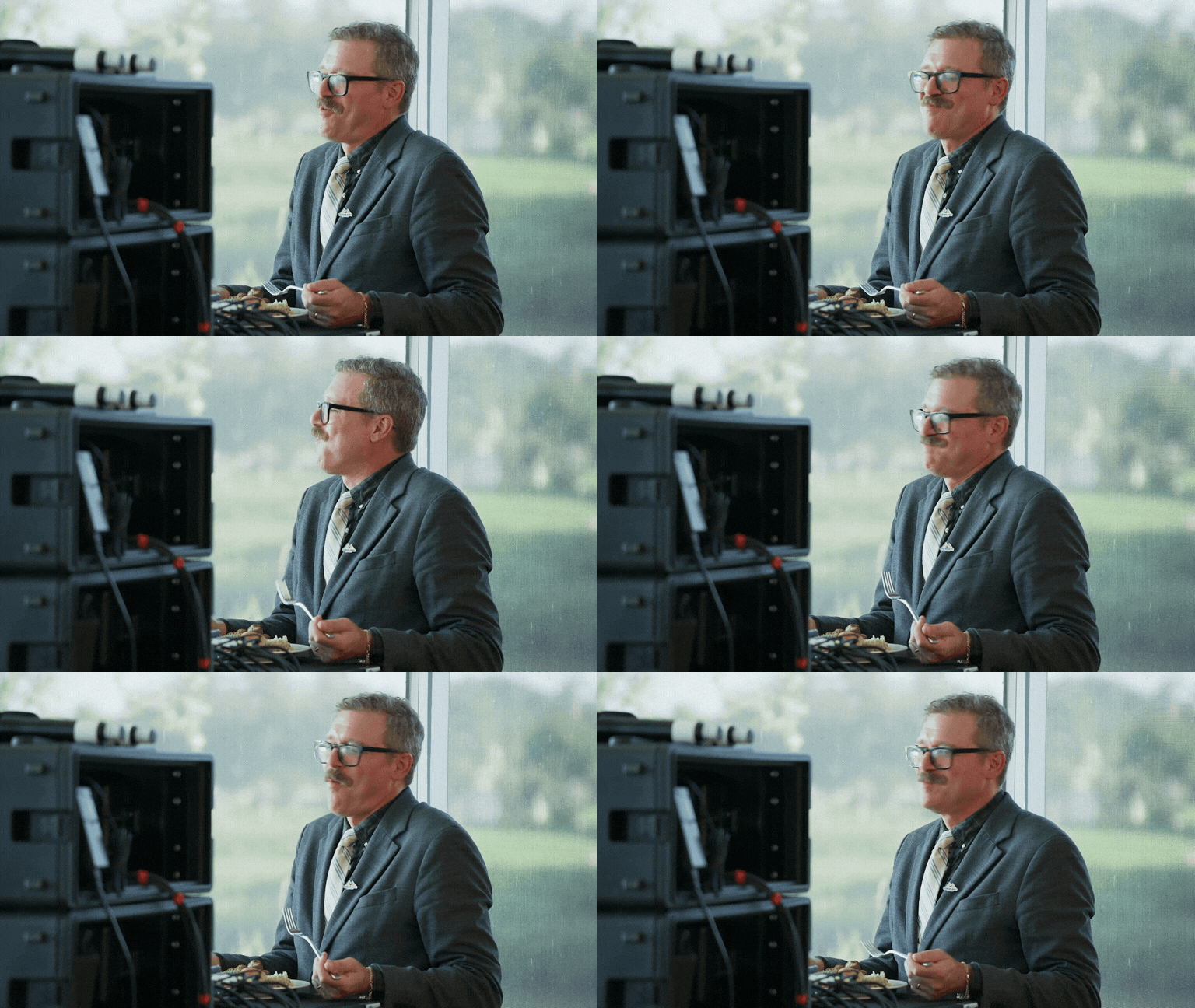
Production Manager Brian Gioielli at a Sketches of Minnesota Event
Conclusion
Hiring did not magically solve every problem. In some ways, it created new ones. We now have to be better managers, better communicators, and better planners. We have to make decisions earlier, document things more clearly, and explain work that used to happen automatically inside our own heads.
But that is also the point.
Hiring has forced Danger Boat to become a more mature business — not a less creative one.
We are still learning how to do this well. We are learning what should be an employee role, what should remain contract-based, what systems need to exist, and where founders still need to get out of the way.
Plus, there’s the fact that people won’t always stay put. Our admin assistant hire ended up leaving to take an exciting new position elsewhere (fly high, Jessica, we miss you <3). Her feedback about her time with us, though, was incredibly important in figuring out what does and doesn’t work for our team.
Future hires will probably look different from these first hires. But this first wave helped us understand something important: growth is not just about doing more work. It is about building the structure that allows good work to happen without everything depending on the same two people all the time.
Now we just have to figure out how to fit “Gioielli Baker Smith” into the company name…

Author: Brandon Boat (he/him)
As co-founder of Danger Boat Productions, Brandon has produced and/or performed in more than 1000 shows that have delighted and surprised audiences throughout the US. In addition to performing, Brandon oversees the logistics of all Danger Boat’s productions and the company’s daily operations and finances as well as cast coordination, client collaboration and so much more.
